
Objective 9: to inspire the pupil to further his or her skills in expressing thoughts and experiences in non-fiction and literary texts
-
You still need a lot of support to write short sentences using the basic vocabulary.

Example: a concrete familiar example about a know subject is given. For example ‘the zoo’. Students can make a word web about the subject and describe their basic knowledge in short sentences.
- Zoos are fun
- Animals are kept in cages
- Animals are fed
Example: Student writes down two lists:
| pro | against |
| animals are fed | animals are locked in cages |
| animals don't get hurt | animals are taken away from nature |
| nice to see different Animals | animals are bored in the zoo |
-
You use pre-defined structures to guide you to form your own opinion.
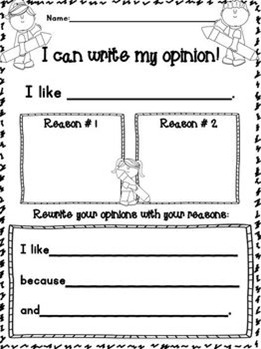
I think that ……….
I have some reasons for this.
My first reason is …
My last reason is …..
Although ……
I think I have shown ………………
-
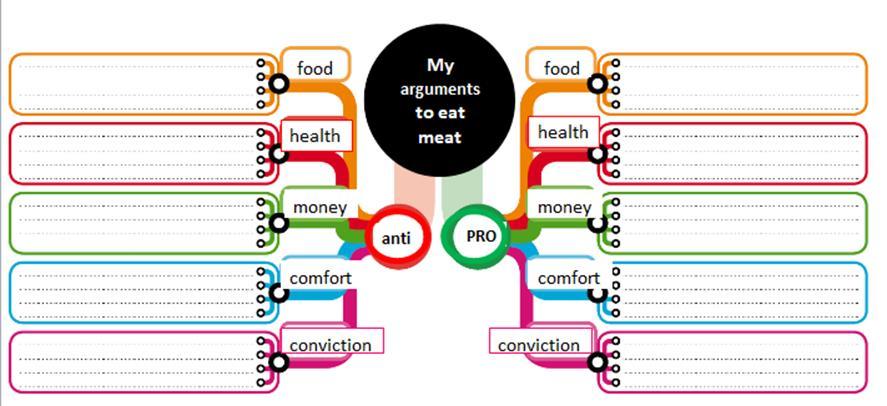
You can provide your opinion in a guided manner with help of tools (peers, dictionary, teacher, framework).
Example: the students are given a subject and with help of opinion words/phrases, they write shortly their opinion about the subject.

-
With guidance, you are able to describe thoughts and experiences in your texts
Example: The teacher helps to shape the opinion, by having group discussion and handing more information about the subject
- Activating previous knowledge/organizing prior experience
- Offering new experience/establishing purposes
- Establishing purposes/formulating questions
- Why, what, when, how, where
- Discussing and planning/locating information
- Study skills/adopting an appropriate strategy
- Interacting with text/retrieval devices/making record
- Reformulating and reflecting/communicating information
-
You are able to tell and explain ideas and experiences in your text.
Example: Same steps can be followed, but without help of the teacher
-
You are able to describe and explain ideas and experiences in your texts, while reflecting and commenting on your own and others' texts.
Example: writing commentary to argumentative text of peers, with well-founded counter-arguments.