
2.5. Determining the age of trees
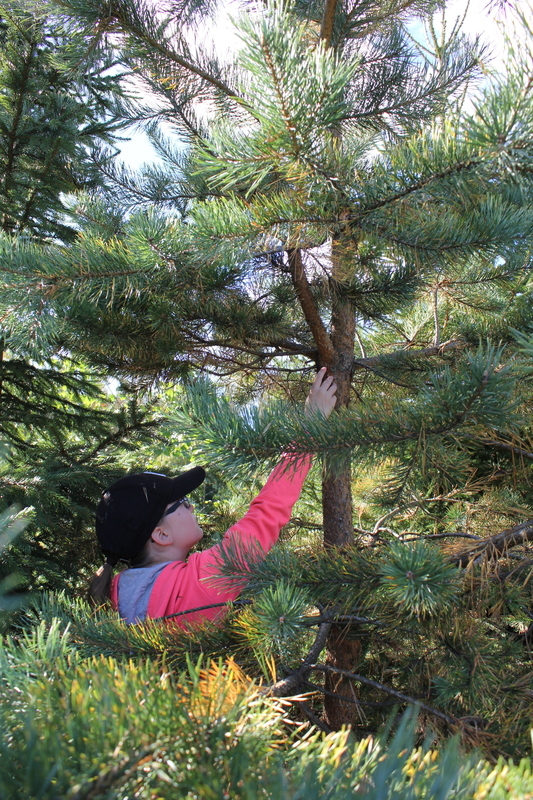 The age of a young pine tree can be determined relatively easily. A pine tree grows one new branch whorl every year. The age of a pine tree can therefore be determined by counting the number of branch whorls.
You can try this yourself by finding a relatively young pine. Count the number of branch whorls. When you have counted all the branch whorls, add another five years to the total. This is done because the youngest branch whorls are invisible. The number you arrive at is a fairly accurate estimate of the age of the pine tree.
The age of a pine branch can be determined in a similar way. Like the pine tree as a whole, its branches too grow new whorls every year.
The age of a tree can also be determined by counting its rings. The rings of tree trunks are results of rapid growth during early spring. The growth slows down when winter approaches. As a result, both a light ring (spring growth) and a dark ring (late summer growth) is formed in the tree trunk each year. When counting all the white rings or all the dark rings of a tree trunk together, the age of the tree can be determined fairly accurately.
The thickness of tree rings tell us about the conditions the tree has experienced during each growing season. For example, warm and humid springs result in thick growth rings, whereas colder springs with little rainfall create thinner rings. This is how yearly growing conditions can be compared by looking at tree rings.
