
5. The structure and significance of plants
Contents

5.1 Plant structure

Plant structure consists of two basic parts: the shoot and the roots. The shoot consists of the stem, leaves, and flowers.
- The stem grows towards sunlight.
- The plant uses its leaves to photosynthesize.
- The plant uses its roots to gather water and nutrients from the soil.
- Many plants reproduce via flowers. Flowers produce pollen and seeds.
All flowering plants have a similar structure. The flower contains colorful leaves called sepals and petals, as well as reproductive structures called stamens and pistils.
Sepals protect the bud of the flower, whereas the colorful petals attract pollinators, such as insects or birds.
Pistils contain the flower's ovaries, whereas stamens produce pollen grains. Stamens and pistils are often located in different flowers of the same plant.
To reproduce, seed plants need to be pollinated. During pollination, the pollen grain produced by the stamens of one flower are transported to the ovaries of another flower's pistil. This results in fertilization, where the nuclei of the pollen cell and the egg cell are united.
Seed plants can be divided into wind-pollinated and insect-pollinated plants. Wind-pollinated plants often have humble-looking flowers. Their drooping stamens produce light pollen grains that the wind carries to another flower's pistil. Birch is an example of a wind-pollinated plant.
In contrast, the flowers of insect-pollinated plants are often large, colorful, and scented. These features attract insects to feed on the flower's nectar and to transport pollen from one flower to another at the same time.
After pollination, the cells of the pollen grain and the egg cell are combined in a process known as fertilization. The fertilized egg cell of the pistil develops into a seed, which in time becomes a new plant in itself.
Pollination and fertilization.
5.2 Plants are producers
Forest ecosystem consist of producers and consumers. Producers are organisms that are capable of producing the energy they require themselves. Green plants are the most significant producers of the forest. They gain their energy from sunlight. They convert this energy to chemical compounds such as sugar during a process known as photosynthesis. Consumers gain their energy by eating other organisms that contain these chemical compounds originating from plants.

A birch forest during the summer. Birch trees and other green plants convert the energy they receive from sunlight into chemical form.
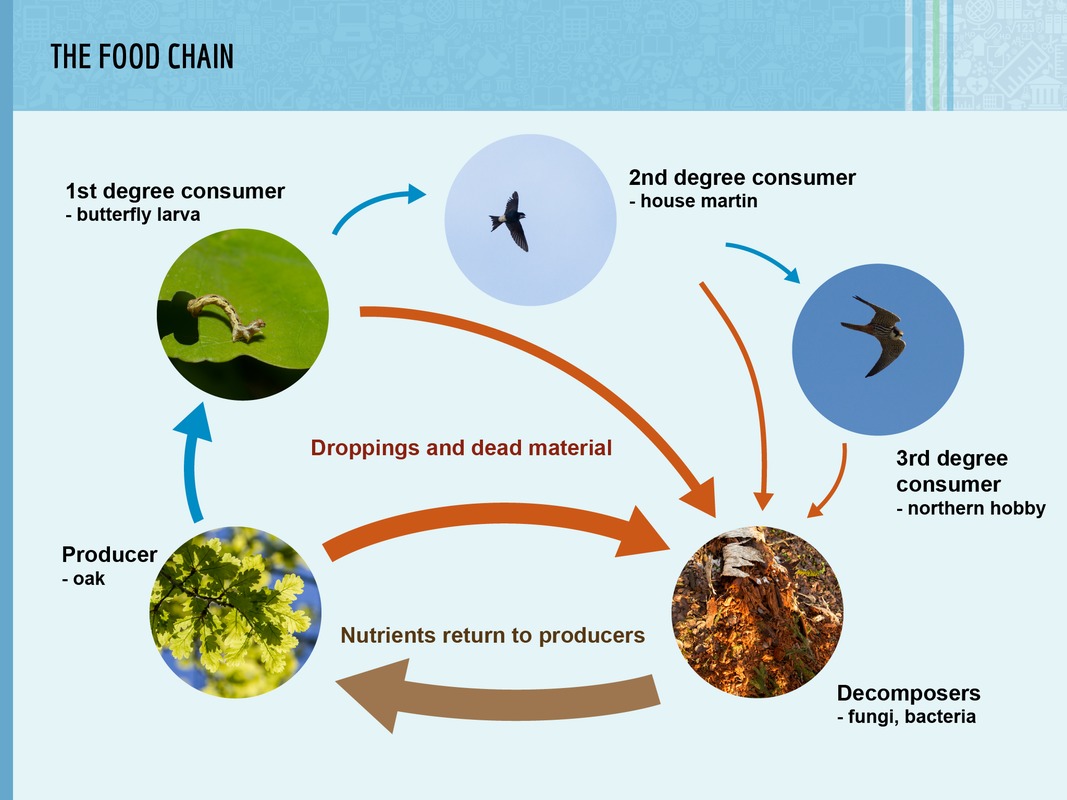
Herbivores are consumers that eat plants, whereas predators are consumers that eat other consumers. The forest's producers and consumers form food chains. In these food chains, the energy bound by producers travels from consumer to consumer.
Let's consider an example of a food chain. An oak tree binds energy it gathers from sunlight and converts it into sugars. The tree uses these sugars as its source of energy to grow and develop. However, the leaves of the oak can also be consumed by a butterfly larva. The larva is a consumer that uses the sugars produced by the oak as its food. When the larva metamorphoses into a butterfly, it can become the food of a insect-eating bird. In turn, this bird can become the prey of a larger predator bird. In time, all these organisms will die, and the chemical compounds contained in their bodies will return to the soil to be decomposed by bacteria, fungi, and invertebrates. This is how the energy produced by plants flows through ecosystems. The nutrients contained in dead organisms ultimately return to the soil as they decompose. From there, it is once again accessible to producers.
In summary, food chains consist of
- producers or green plants.
- 1st degree consumers or herbivores.
- 2nd and 3rd degree consumers that are predators.
5.3 Photosynthesis
Producers gain their energy from solar radiation in a process called photosynthesis. The cells of green plants contain specialized organelles called chloroplasts. These chloroplasts contain pigments that gather sunlight, the most important of which is the green pigment called chlorophyll.
In the chloroplasts of plant cells, the energy from sunlight is converted into chemical energy. The energy from solar radiation is bound into chemical compounds such as sugars. The ingredients required by plants to create sugar are water and carbon dioxide. As they convert these ingredients into sugars, the plants also release oxygen into the atmosphere.
6 CO2 + 6 H2O + sunlight ➞ C6H12O6 + 6 O2
carbon dioxide + water + sunlight ➞ sugar + oxygen
Plants use the sugars produced during photosynthesis as their source of energy. Plants store some of the excess sugar into their roots in the form of starch. During photosynthesis, carbon dioxide is removed from the atmosphere, and the carbon contained by it is bound into the plant's cell tissue.
5.4 Plants compete for sunlight
Plants need to photosynthesize in order to grow. To photosynthesize, plants require sunlight. Because of this, plants often have to compete with each other for sunlight. This is why plants such as trees strive to grow tall.
Different species of plants have adapted into different light conditions. Plants such as pine and lingonberry are light plants. They require a lot of sunlight in order to grow. Their small leaves are resistant to light and heat due to their thick structure and their protective wax layers.
In contrast, plants such as wood sorrel and chickweed wintergreen are shade plants. Their leaves are thin, broad, and located on the top of the plant's stem. They have adapted into conditions where sunlight is scarce, such as the forest floor.

Shade plants have thin, broad leaves. Leaves of wood sorrel and liverleaf.
- The tree layer is the highest layer of vegetation. It comprises of all coniferous trees, broadleaf trees, and shrubs over two meters tall.
- The shrub layer consists of shrubs and tree saplings that are under two meters tall. Species such as juniper and willow often occupy the shrub layer of a forest.
- The layer consisting of short sprigs and grasses is known as the the field layer. The common species of the field layer include blueberry, heather, wavy hair-grass, and goldenrod.
- The lowest layer of vegetation in a forest is the ground layer. It consists mainly of different mosses and lichens.
5.5 Plant cells
Plants, like all other organisms, consist of cells. Cells are small, but they can be easily studied with a fluorescent microscope, for example.
Plant cells contain various organelles and structures. These include:
- The cell wall, which is the outermost structure of the cell. It protects and supports the structure of the cell.
- The cell membrane, which is a thin layer of plasma that regulates the movement of substances in and out of the cell.
- Cytoplasm, which is a mixture of liquids that is located inside the cell.
- The nucleus, which contains the cell's genome in its chromosomes.
- Chloroplasts, where the process of photosynthesis takes place.
- The vacuole, which is used to store water and other essential substances.

5.6 Cells form tissues

Plant cells can have different structures and functions. Cells with similar structures and functions are combined to form tissues.
Plants contain various kinds of tissues. They have specialized to fulfill different functions: for example, some tissues are specialized in photosynthesis and contain more chloroplasts than other kinds of tissue.
Plant tissues:
- The surface of the plant consist of superficial tissue.
- The upper surfaces of plant leaves contain photosynthetic tissue.
- The inside of the plant's stem and roots contain conducting or vascular tissue. The veins of plant leaves also consist of vascular tissue.
Green plants use specialized structures called stomates to regulate the intake and release of gases such as carbon dioxide and oxygen. These stomates are often located in the leaves of plants.
Plant leaves contain veins that transport water and nutrients to the photosynthetic tissue. When the leaves produce sugar, it is transported all the way to the roots via vascular tissue that runs through the plant's stem.
5.7 Vascular tissue
The trunks of trees consist of different layers. When looking at a cross-section image of a pine trunk, for example, we can notice distinct layers that run through the length of the trunk.
The outermost layer of the tree trunk consists of bark. Its function is to provide protection for the more vulnerable and vital parts of the tree's conducting or vascular tissue. These consist of phloem tissue, the function of which is to transport sugar between different parts of the plant, and the innermost xylem tissue, the function of which is to transport water and nutrients between different parts of the plant. A layer of cambium separates the phloem and the xylem. It consists of thin-walled cambial cells that can divide and differentiate into either xylem or phloem cells.

The cambial cells divide and differentiate the most during the spring. During this time, the innermost part of the tree develops new layers of light, young xylem tissue. During the summer, the divison of cambial cells slows down, resulting in a darker layer of xylem growth. Together, these light and dark layers of xylem form the tree's growth rings, which can be used to determine the age of a tree.