
11. Forests and humans
Contents

11.1 Forests change over time
 The species of a forest change over time. This process is known as succession. In Finland, the succession of a forest from a clearing to an old, natural forest takes approximately between 100 and 200 years.
After a forest fire or clear-cutting the forest has no trees and the forest floor receives a lot of light. In these kinds of conditions, pioneer species of rapidly radiating light plants distribute and grow rapidly. Plants such as rosebay willowherb, raspebrry, willow, and birch are all examples of such pioneer species. They are the first plants to take over a forest clearing.
As some pioneer species grow taller than other pioneer plants, the amount of light that arrives on the forest floor begins to decrease. As a result, the initial grassland stage gives way to a shrubland stage, where broadleaf plants dominate the higher vegetation layers of the forest.
Painting on the right: Many Finnish forests were slashed and burned for agricultural use over a hundred years ago. Eero Järnefelt (1863-1937): Burning the Brushwood / Under the Yoke.
Protected by the foliage of broadleaf trees, the saplings of conifers will also begin to grow taller. As a result of this, the shrubland gradually transforms into a mixed forest. Mixed forests have a high level of plant diversity: they contain both broadleaf and coniferous trees as well as various shrubs and grasses.
Coniferous trees such as pine and spruce are better suited to the climatic conditions of Northern Europe than broadleaf trees are. Because of this, it is common that a mixed forest will gradually transform into a coniferous forest over time.
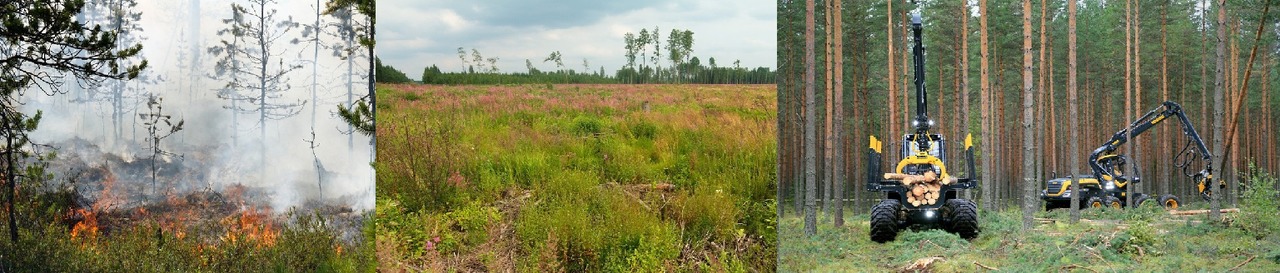
The development from a fire clearing into a coniferous forest takes between 80 and 200 years, depending on the location.
As the plant life of a forest develops as a result of succession, the animal community of the forest also changes. A forest at its grassland stage is favoured by small mammals such as voles and birds such as the tree pipit, whereas shrublands usually accommodate mountain hares and willow warblers.
Mixed forests contain a large variety of different food plants. This attracts both herbivores and predators into mixed forests. As a result, birds such as trushes and chaffinches and herbivorous mammals such as the moose can be found in mixed forests. As the mixed forest transforms into an old, coniferous forest, its animal community once again changes. The tall trees of an old forest provide food and protection for species such as the goldcrest, the wood grouse, and the great spotted woodpecker.
| Stage | Vegetation | Animal community | Other |
|---|---|---|---|
| Clearing | Grasses and other light plants. | Species adapted to open environments, such as small rodents. | Large variation in temperature between day and night. |
| Shrubland | Willow, birch. | Willow warbler, yellowhammer. | Young birch trees begin to take over the forest. |
| Mixed forest | Birch, aspen. | Large species diversity: herbivores, predators, various birds. | Rapid tree growth. |
| Coniferous forest | Pine. | Herbivores, predators, birds. | The clearing turns into a coniferous forest in approximately 80 years. |
| Old forest | Mostly spruce. | Woodpeckers, wood grouse. | Slow tree growth. |
11.2 Gallery: Succession


11.3 "The land of green gold"

Finland is known around the world as a forest nation. This is true: over 78 % of the nation's surface area consists of forested areas. Finland is also known as a land of lakes, although they take up only approximately ten percent of the nation's total surface area.
There are approximately 4 hectares of forest per every Finnish citizen. Elsewhere in Europe, the average is 1,3 hectares of forest per citizen. This means that Finnish forest truly are something to be proud of.
Forests are the "green gold" of Finland. Forestry continues to be an important livelihood for many Finns, producing wood that is used in the paper industry, construction and energy production.
11.4 Goods and reproduction
In Finland, everyone has a right to move freely in the nation's forests and to make use of forest goods, such as berries and fungi. These rights are specified in the list of Finnish everyman's rights.
As a result of everyman's rights, it is possible for people to move in Finnish forests and nature without a special permission from the landowner. Everyman's rights also dictate that berries can be freely picked from forests for personal use. Different berries are picked during different times of the year: blueberries and cloudberries can be picked already in July, whereas lingonberries can be found in forests between August and October. Berries are important forest goods. They are healthy and nutritious, and berry picking is a useful form of exercise.
 Cloudberries can be found in bogs during the late summer and autumn.
Lichens are also picked from forests. They are used as decorative elements and imported all around the world. Economically, the most important type of Finnish lichen is reindeer lichen, which is primarily harvested in the Ostrobothnia and Kainuu regions.
Hunting has been an important source of food, resources and income for Finns throughout their history. Nowadays, hunting is mostly a recreational hobby.
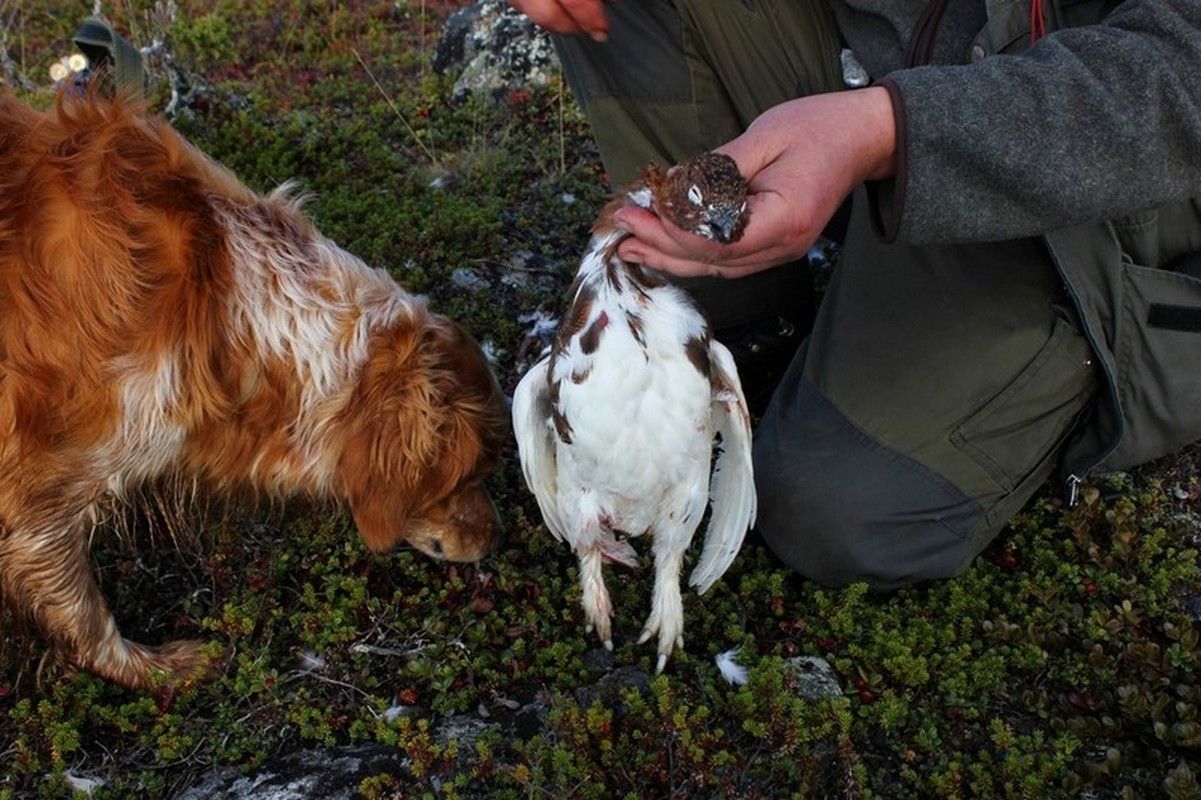 Hunting is one way to use the forest. The willow grouse in the picture has been caught and killed.
Moving in the forest is good for both your physical and mental health. You can move in the forest in various different ways, either alone, together with other people, or with a pet. Some people like running on forest trails, whereas others enjoy activities like geocaching or birdwatching. These are just some of the various kinds of recreational activities one can do in the forest.
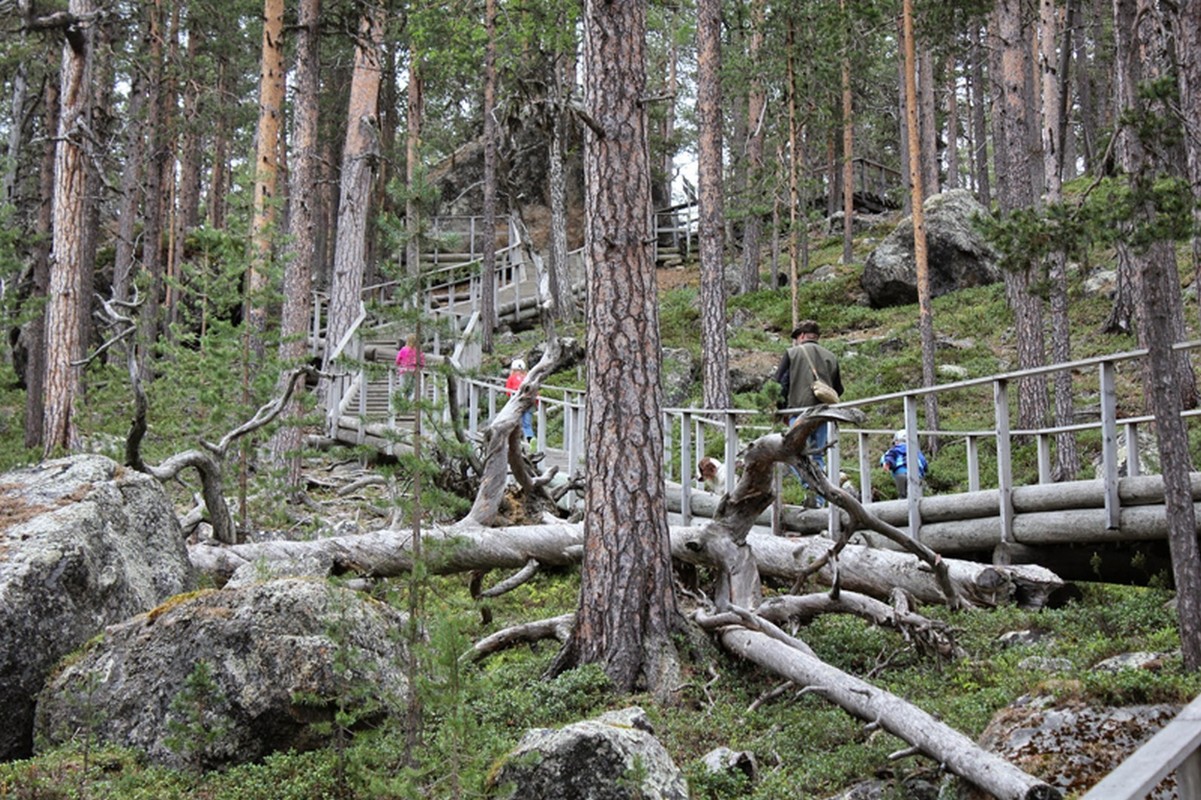 Finns like walking in the nation's many forests. Structures such as duckboards and stairs have been built along some forest paths to make movement in the forest easier and less damaging to the natural environment.