
2. How to study a forest?
Contents
2.1 Study and learn
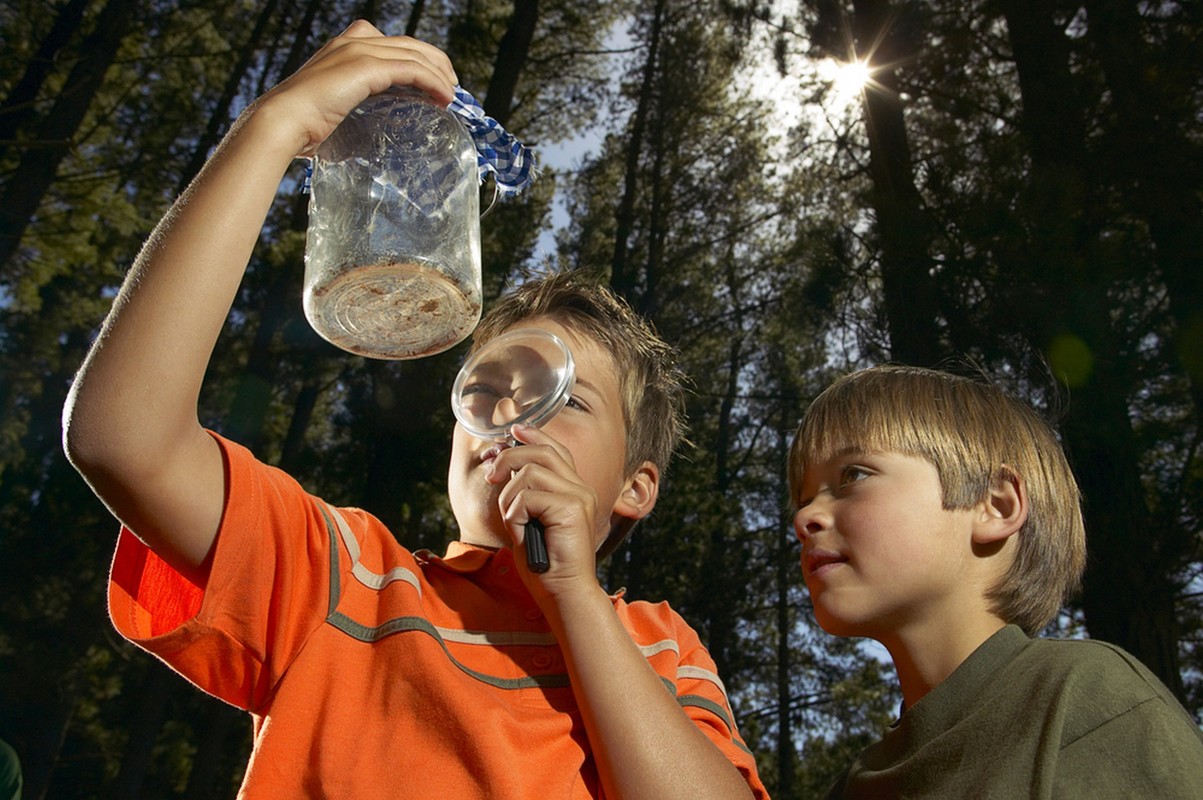
Studying things by yourself is one of the best ways to learn about the natural world. When studying organisms in their natural environment, the knowledge you have acquired from books and biology classes is combined with your own experiences, observations, and thoughts. When studying things yourself, you will also be able to remember it better. Observing the natural world also makes you receptive to details of the natural world that are often left unnoticed.

If you do not recognize a plant, take pictures of it! A student taking a picture of interrupted club moss, which is a relatively common spore plant.
If you do not recognize a plant, take pictures of it! A student taking a picture of interrupted club moss, which is a relatively common spore plant.
2.2. What do biologists do?
The job of the biologist often takes the form of basic research. In basic research, knowledge of the world around us is sought for its own sake, without looking for immediate benefit from the discoveries made. For example, basic research can take the form of questions such as "What kinds of species live in this area?" and "How do the species interact with each other?".
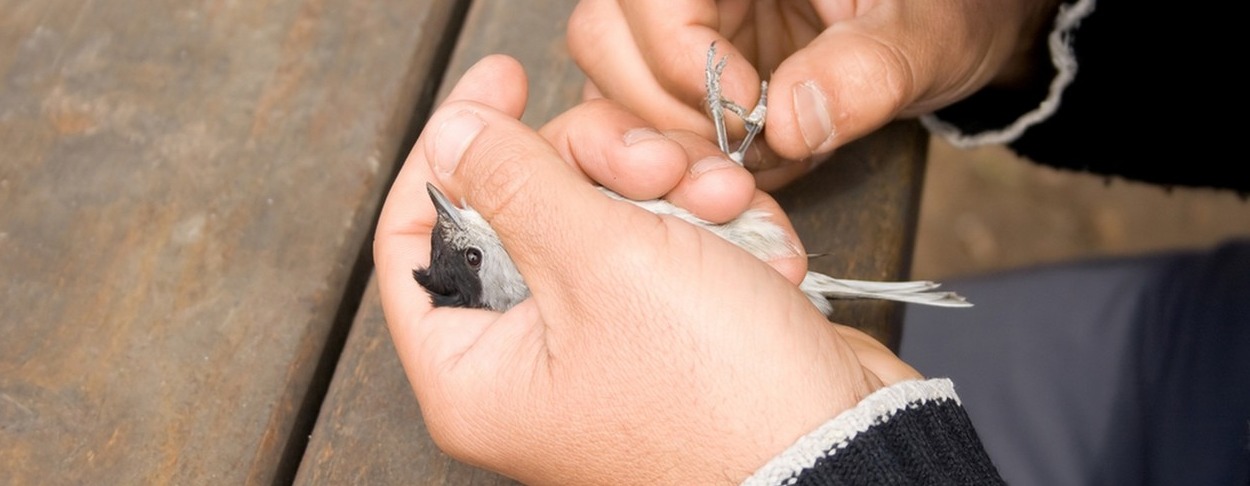
Ringing is a way to gain information about the movement of birds. Blackcap.
Biological research can be either observational or experimental.
In observational research the researcher observes the subject of the study in its natural state. The researcher can measure or take samples from the subject, but they cannot make actual alterations to the research set-up. Esimerkiksi lintulajien levinneisyyden muutokset tai puutiaisten runsaus selviää vain tekemällä havaintoja.
The goal of a biological experiment is to test the validity of a certain observation or phenomenon. Biological experiments aim to modify only one variable while keeping all other variables that could affect the phenomenon constant.
For example, when researching the influence of air temperature on the growth of a dandelion, the amount of light and water must be kept constant throughout the experiment. This means that only the temperature is varied: some dandelions are grown in a cold environment, whereas some are grown in a warm environment. A control group, for which the variable is not changed, is also incorporated into the experiment. By doing so, a so-called zero value, to which the results of the experiment can be compared, is obtained.

The nestlings of a great tit pair. If the researcher increases the amount of nestlings, fewer of them survive to maturity.
Based on previous observations the researcher devises one (or several) hypothesis. A hypothesis is a probable explanation for the phenomenon studied. After devising one, the researcher tests the validity of their hypothesis by making predictions based on it. These predictions can be tested by making observations or by devising experiments.
The researcher often sets out clear research questions which aim to discover the validity of their predictions. The experiment must be repeated for a number of times before the universatility or applicability of the results can be declared. If the predictions are not fulfilled, the hypothesis is discovered to be wrong and it must be rejected.
The nature of the scientific method requires that a hypothesis is never fully accepted. Thus, it can always be refuted based on new information.
For example, "all swans are white" was a reasonable and accepted hypothesis until the discovery of Australia and the populations of black swans that resided there. When this happened, the previous hypothesis had to be rejected. This principle of research leads to scientific information becoming constantly more accurate and self-correcting.
Repeatability is an important feature of biological studies. This is why a detailed report of the experiment, its methods and its results is required.
If other studies arrive at similar results and conclusions, the results of the study can be considered reliable. A scientific explanation for the phemomenon, a theory, can then be assembled based on the information on the phenomenon studied.
Ringing is a way to gain information about the movement of birds. Blackcap.
Biological research can be either observational or experimental.
In observational research the researcher observes the subject of the study in its natural state. The researcher can measure or take samples from the subject, but they cannot make actual alterations to the research set-up. Esimerkiksi lintulajien levinneisyyden muutokset tai puutiaisten runsaus selviää vain tekemällä havaintoja.
The goal of a biological experiment is to test the validity of a certain observation or phenomenon. Biological experiments aim to modify only one variable while keeping all other variables that could affect the phenomenon constant.
For example, when researching the influence of air temperature on the growth of a dandelion, the amount of light and water must be kept constant throughout the experiment. This means that only the temperature is varied: some dandelions are grown in a cold environment, whereas some are grown in a warm environment. A control group, for which the variable is not changed, is also incorporated into the experiment. By doing so, a so-called zero value, to which the results of the experiment can be compared, is obtained.
Why do great tits lay only 10 eggs on average in certain areas, but rarely more? When this was studied, the findings suggested that nests of exactly 10 eggs were the most common. Could the reason behind this phenomenon be natural selection, which has guided great tits to lay approximately 10 eggs in this certain area?
The matter was researched by using an experimental study.
- A set of 30 10-egg nests from the area was selected for the study.
- Three eggs were moved from 10 of these nests to 10 other nests.
- After this, the growth and survival of the nestlings from these nests was studied.
- The results are shown in the chart below.
| Broods | Body weight of nestlings on average at age of 15 d | Number of fledglings (surviving offsprings) on average | |
|---|---|---|---|
| Reduced broods (7 eggs) | 17 g | 5,5 | |
| Normal-sized broods (10 eggs) | 15 g | 8,8 | |
| Enlarged broods (13 eggs) | 11 g | 6,5 |
The results support the assumption that birds usually lay the amount of eggs that is most optimal for the production of offspring.
The nestlings of a great tit pair. If the researcher increases the amount of nestlings, fewer of them survive to maturity.
Based on previous observations the researcher devises one (or several) hypothesis. A hypothesis is a probable explanation for the phenomenon studied. After devising one, the researcher tests the validity of their hypothesis by making predictions based on it. These predictions can be tested by making observations or by devising experiments.
The researcher often sets out clear research questions which aim to discover the validity of their predictions. The experiment must be repeated for a number of times before the universatility or applicability of the results can be declared. If the predictions are not fulfilled, the hypothesis is discovered to be wrong and it must be rejected.
The nature of the scientific method requires that a hypothesis is never fully accepted. Thus, it can always be refuted based on new information.
For example, "all swans are white" was a reasonable and accepted hypothesis until the discovery of Australia and the populations of black swans that resided there. When this happened, the previous hypothesis had to be rejected. This principle of research leads to scientific information becoming constantly more accurate and self-correcting.
Repeatability is an important feature of biological studies. This is why a detailed report of the experiment, its methods and its results is required.
If other studies arrive at similar results and conclusions, the results of the study can be considered reliable. A scientific explanation for the phemomenon, a theory, can then be assembled based on the information on the phenomenon studied.
| Defining a question | Gather information and define a question. |
| Hypothesis | Make a testable prediction which designates the relationship between two or more variables. |
| Operational definition | Define the variables and how they will be measured or assessed in the study. |
| Data collection | Collect data of the phenomenon. |
| Data analysis | Analyse your data carefully. Make tables, figures and pictures, and then describe them in words. |
| Test, revising of hypothesis, conclusion | Publish your results. |
2.3 Tools and methods for studying forests
Forest biology contains an innumerable amount of different subjects for research. There are animals, plants, fungi and microbial organisms. The research can focus either on the ecosystem as a whole or even in individual genes of specific organisms. Because of this, different kinds of research necessitate different tools and methods.
The most common methods of studying forest plants are vegetation squares and lines. When using squares or lines to study forest vegetation, a rectangular patch of land is selected and focused on. The plants contained within this area are counted, identified, and studied. This gives an estimate of the distribution rates of different plants, which can then be used to compare the plant life of different forests and regions.
In zooecological research, observing or catching the animals studied often proves harder than when researching plants. Binoculars, telescopes and cameras with long object lenses are useful tools for observing and studying birds. Birds can also be caught for ringing, which is useful when studying the movement patterns of individuals and populations. Small mammals can be caught with traps that are designed in such a way that they do not harm the animals. Invertebratic animals, such as insects, are caught with nets, light traps and pit fall traps.

Birds can be studied with binoculars and cameras.
The most common methods of studying forest plants are vegetation squares and lines. When using squares or lines to study forest vegetation, a rectangular patch of land is selected and focused on. The plants contained within this area are counted, identified, and studied. This gives an estimate of the distribution rates of different plants, which can then be used to compare the plant life of different forests and regions.
In zooecological research, observing or catching the animals studied often proves harder than when researching plants. Binoculars, telescopes and cameras with long object lenses are useful tools for observing and studying birds. Birds can also be caught for ringing, which is useful when studying the movement patterns of individuals and populations. Small mammals can be caught with traps that are designed in such a way that they do not harm the animals. Invertebratic animals, such as insects, are caught with nets, light traps and pit fall traps.
Birds can be studied with binoculars and cameras.
2.4. Growing plants
 Growing things yourself is a good way to learn more about the way in which plants function and develop. The following is an example.
- Place oat and radish seeds in pots filled with soil.
- Mark the pots so that you know what seeds have been planted in them. Make note of the number of seeds you have planted.
- Use the information in the bags of seeds to determine how deep in the soil the seeds should be planted. Oat seeds are often planted approximately one centimeter deep in the soil, whereas the planting depth of radish seeds can vary.
- Cover the seeds with soil.
- Leave the pots in room temperature, in a place that gets plenty of sunlight (e.g. near a window).
- Make sure that the soil is wet throughout the cultivation period. You can prevent moisture from evaporating by placing translucent pieces of plastic on top of the pots.
- Observe the growth of the seedlings. How are they different?
2.5. Determining the age of trees
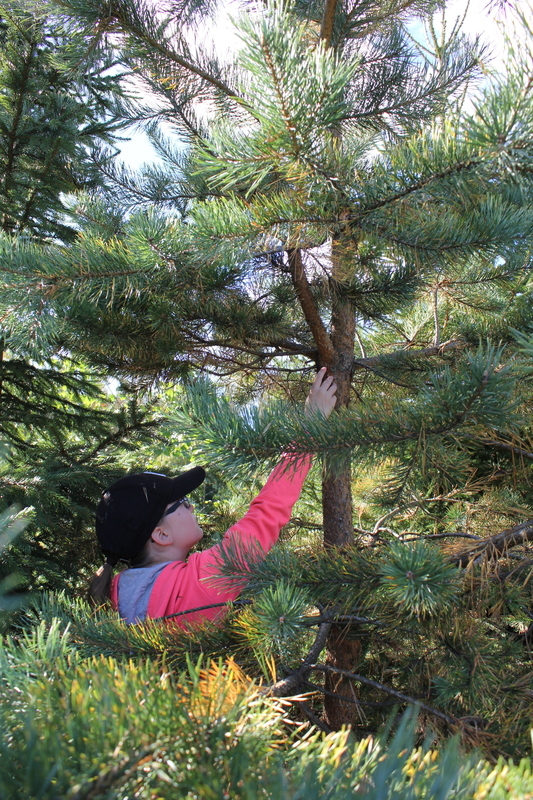 The age of a young pine tree can be determined relatively easily. A pine tree grows one new branch whorl every year. The age of a pine tree can therefore be determined by counting the number of branch whorls.
You can try this yourself by finding a relatively young pine. Count the number of branch whorls. When you have counted all the branch whorls, add another five years to the total. This is done because the youngest branch whorls are invisible. The number you arrive at is a fairly accurate estimate of the age of the pine tree.
The age of a pine branch can be determined in a similar way. Like the pine tree as a whole, its branches too grow new whorls every year.
The age of a tree can also be determined by counting its rings. The rings of tree trunks are results of rapid growth during early spring. The growth slows down when winter approaches. As a result, both a light ring (spring growth) and a dark ring (late summer growth) is formed in the tree trunk each year. When counting all the white rings or all the dark rings of a tree trunk together, the age of the tree can be determined fairly accurately.
The thickness of tree rings tell us about the conditions the tree has experienced during each growing season. For example, warm and humid springs result in thick growth rings, whereas colder springs with little rainfall create thinner rings. This is how yearly growing conditions can be compared by looking at tree rings.
