
11.1 Forests change over time
 The species of a forest change over time. This process is known as succession. In Finland, the succession of a forest from a clearing to an old, natural forest takes approximately between 100 and 200 years.
After a forest fire or clear-cutting the forest has no trees and the forest floor receives a lot of light. In these kinds of conditions, pioneer species of rapidly radiating light plants distribute and grow rapidly. Plants such as rosebay willowherb, raspebrry, willow, and birch are all examples of such pioneer species. They are the first plants to take over a forest clearing.
As some pioneer species grow taller than other pioneer plants, the amount of light that arrives on the forest floor begins to decrease. As a result, the initial grassland stage gives way to a shrubland stage, where broadleaf plants dominate the higher vegetation layers of the forest.
Painting on the right: Many Finnish forests were slashed and burned for agricultural use over a hundred years ago. Eero Järnefelt (1863-1937): Burning the Brushwood / Under the Yoke.
Protected by the foliage of broadleaf trees, the saplings of conifers will also begin to grow taller. As a result of this, the shrubland gradually transforms into a mixed forest. Mixed forests have a high level of plant diversity: they contain both broadleaf and coniferous trees as well as various shrubs and grasses.
Coniferous trees such as pine and spruce are better suited to the climatic conditions of Northern Europe than broadleaf trees are. Because of this, it is common that a mixed forest will gradually transform into a coniferous forest over time.
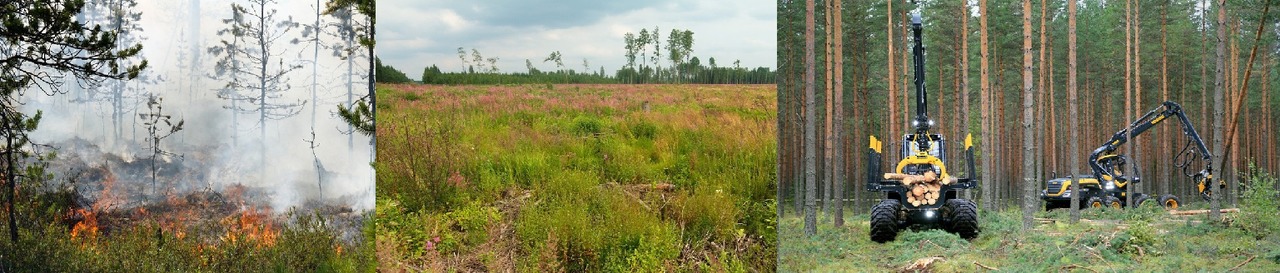
The development from a fire clearing into a coniferous forest takes between 80 and 200 years, depending on the location.
As the plant life of a forest develops as a result of succession, the animal community of the forest also changes. A forest at its grassland stage is favoured by small mammals such as voles and birds such as the tree pipit, whereas shrublands usually accommodate mountain hares and willow warblers.
Mixed forests contain a large variety of different food plants. This attracts both herbivores and predators into mixed forests. As a result, birds such as trushes and chaffinches and herbivorous mammals such as the moose can be found in mixed forests. As the mixed forest transforms into an old, coniferous forest, its animal community once again changes. The tall trees of an old forest provide food and protection for species such as the goldcrest, the wood grouse, and the great spotted woodpecker.
| Stage | Vegetation | Animal community | Other |
|---|---|---|---|
| Clearing | Grasses and other light plants. | Species adapted to open environments, such as small rodents. | Large variation in temperature between day and night. |
| Shrubland | Willow, birch. | Willow warbler, yellowhammer. | Young birch trees begin to take over the forest. |
| Mixed forest | Birch, aspen. | Large species diversity: herbivores, predators, various birds. | Rapid tree growth. |
| Coniferous forest | Pine. | Herbivores, predators, birds. | The clearing turns into a coniferous forest in approximately 80 years. |
| Old forest | Mostly spruce. | Woodpeckers, wood grouse. | Slow tree growth. |