
4.5 What causes post-glacial rebound?
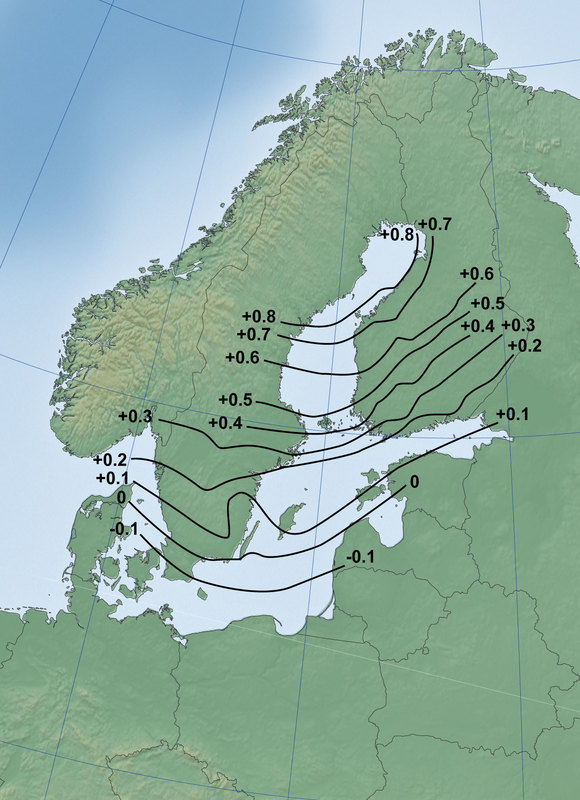 During the last Ice Age, the majority of Fennoscandia was covered by a continental glacier that was almost three kilometers thick. The enormous weight of the glacier caused a lot of pressure to mount against the Earth's crust.
As a result of this pressure, the crust of the Earth sank deep into the planet's mantle, forming a hole that was almost a kilometer deep. Material from the top layer of the Earth's mantle moved towards the edges of this hole.
As the climate grew warmer, the continental glacier began to melt. This made the pressure it caused against the Earth's crust to decrease. In addition, materials that had moved to the edges of the pressurized area began to move towards the center of the hole. This resulted in post-glacial rebound.
At first, post-glacial rebound was extremely fast. Over time, the process has slowed down. Today, the ground rises by only eight millimeters each year at the highest.
Post-glacial rebound occurs at the greatest rate near the Bothnian Bay, because the region was the last to be cleared of the continental ice mass when it retreated to the northwest. In Southern Finland, post-glacial rebound occurs at a rate of 2 millimeters per year, whereas in Southern Sweden no post-glacial rebound takes place.
During the millennia that have followed the last ice age, the ground has risen approximately 300 m. Post-glacial rebound is thought to continue, and the land is thought to rise for another 100–150 meters over the course of the next ten thousand years. This process is gradually slowing down as to the planet's crust returns to its original level.