
4.4 Stages of the Baltic Sea
In geological terms, the Baltic Sea is a young sea. Its history has been researched by studying the fossils left by water-dwelling gastropods and clams. By studying their shells, the salt concentration and temperature of the seawater can be estimated. This gives us more information about the history of the Baltic Sea.
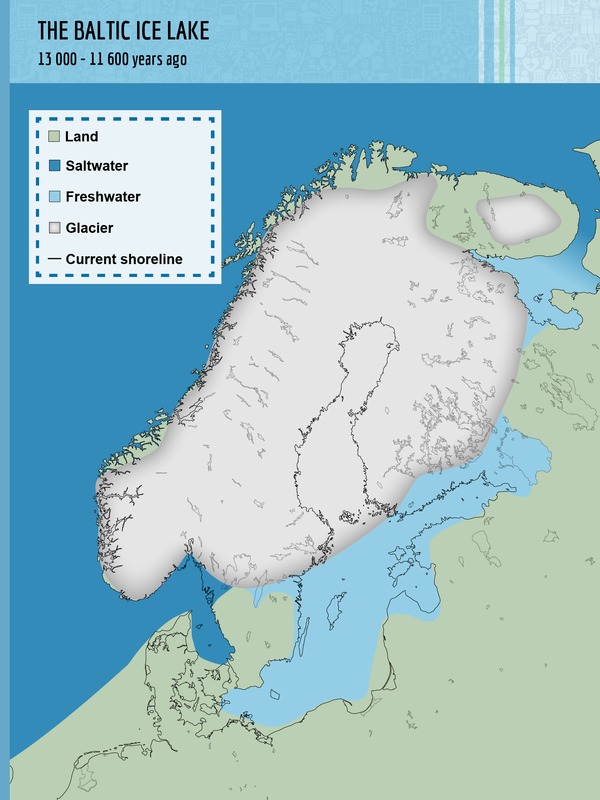
The history of the Baltic Sea consists of four distinct stages. Two of these stages are saltwater sea stages, whereas the other two are freshwater lake stages:
The history of the Baltic Sea consists of four distinct stages. Two of these stages are saltwater sea stages, whereas the other two are freshwater lake stages:
- The Baltic Ice Lake. 13 000 – 11 600 years ago. The water of the melting glacier formed a cold lake.
- The Yoldia Sea. 11 600 – 10 800 years ago. The sea was formed when a strait was formed near Central Sweden, connecting the Baltic Ice Lake with the North Sea. Southern Finland was covered by the sea. The seafloor accumulated a lot of clay and other materials.
- The Ancylus Lake. 10 800 – 9 000 years ago. Post-glacial rebound caused the strait to the North Sea to become disconnected. The water of the Baltic became fresh once again.
- The Litorina Sea. 9 000 – 3 000 years ago. The surfaces of the planet's oceans rose, creating another link with the North Sea via the straits of Denmark. When the land continued to rise due to post-glacial rebound, the connection with the North Sea became more narrow. The modern Baltic Sea became to form approximately 2 000 years ago.
 |
 |
 |
 |