
4.2 Post-glacial rebound
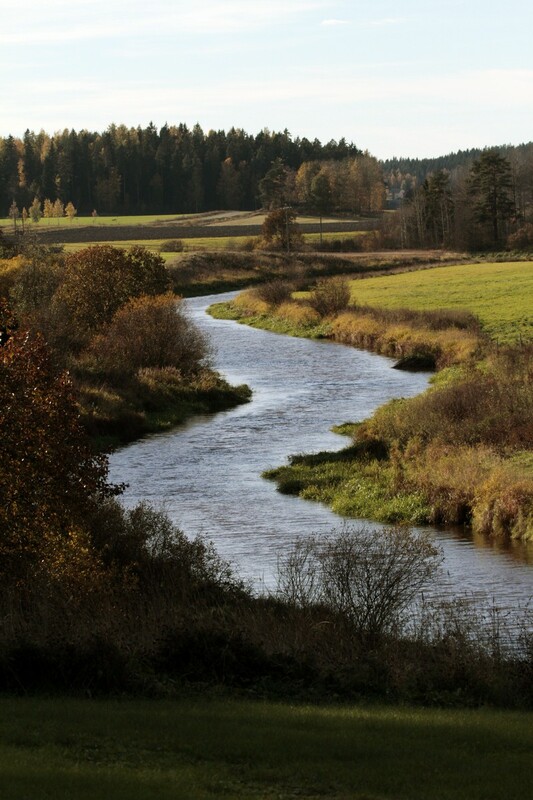 Finnish environments show many signs of being submerged by water once upon a time. In fact, many Finnish hills used to be islands and islets.
Fine soil has accumulated near the depressions between different hills and formed clay valleys. This process continues to this day. The picture on the right shows a river valley in Tavastia Proper, where clay has accumulated in a valley in the ancient seafloor.
Small islets are connected to each other, become islands and are finally connected with the continent. The largest island in the Bothnian Bay, Hailuoto, is a good example of this process.
Post-glacial rebound causes ground to rise in certain areas. This process makes the Finnish land surface area grow by seven square kilometers every ear. At the same time, the Bothnian Bay is slowly transforming into a lake. This will happen in two thousand years, when the ground of the Kvarken has risen above the sea level.
The shores of Ostrobothnia are slowly moving further towards the sea, transforming former coastal cities into inland cities. This has happened in Ulvila, for example, which was originally formed near the seashore but is now an inland town.
Post-glacial rebound has also resulted in many bodies of water being separated from the Baltic Sea. This has resulted in the formation of several Finnish lakes, such as Lake Saimaa. The animal species that have survived the change from saltwater into freshwater ecosystem, such as the Saimaa ringed seal, are examples of relic species.
Post-glacial rebound will cause Ostrobothnian rivers to flood more drastically in the future. Because the mouths of these rivers will rise, the flow speed of the rivers will also decrease. In addition, the Finnish landmass is slowly angling towards the southwest, which has caused changes in the flow directions of certain rivers. For example, the waters of the Lake Päijänne used to flow into the Gulf of Bothnia, but approximately 6 000 years ago they began to flow towards the south. Today, the waters of Lake Päijänne flow into the Gulf of Finland via the Kymijoki river.
Finnish inland areas have been covered by the sea or various freshwater bodies during the post-glacial period. This has resulted in the formation of ancient shores, where the waves have smoothed down rocks and piled up sandbanks near hills and ridges. Sometimes, these waves have carried away all the loose material except for the large rocks. This has caused the formation of rocky shingle beaches. As a result of post-glacial rebound, these beaches can today be found even at elevations of 200 meters!

A shingle beach in Nunnavuori, Turku.