2.3 Longitudes and latitudes
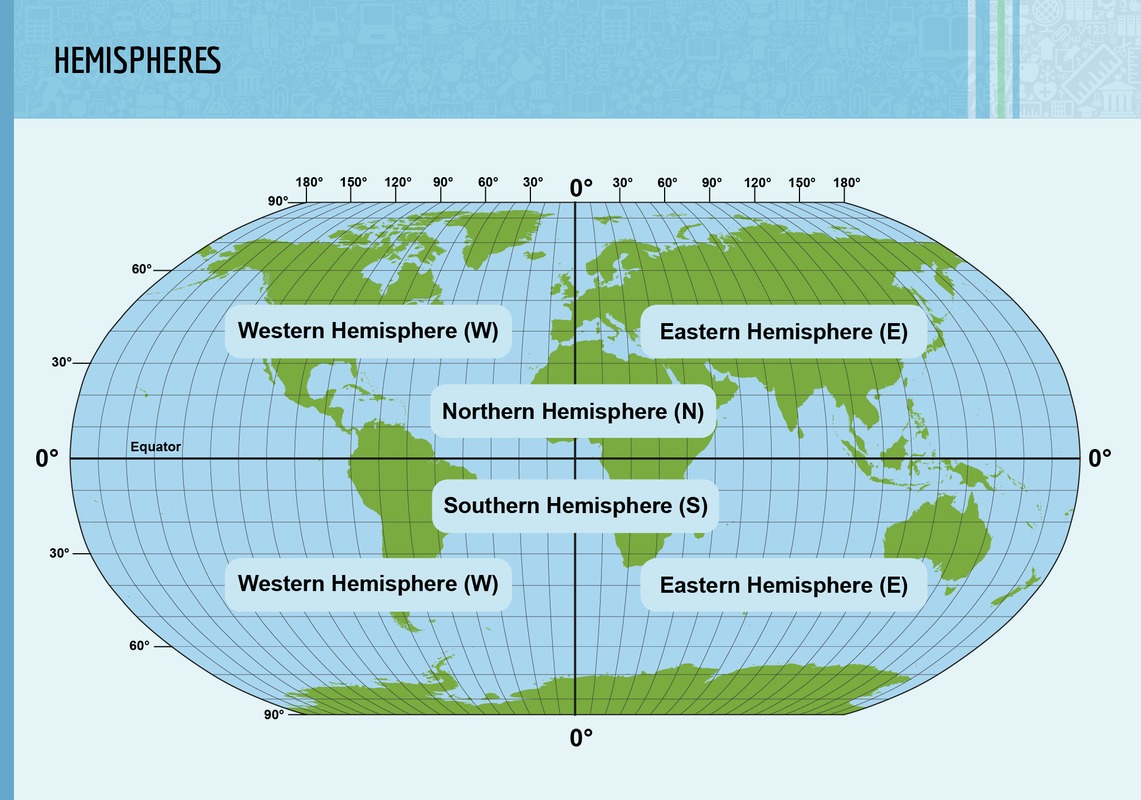
When you look at a world map, you will notice horizontal and vertical lines running across the Earth. The horizontal lines, running between from west to east, are called latitudes. The latitudes travel in the same direction without ever touching each other. The longest of these lines is the equator, which divides planet Earth into its northern (N) and southern (S) hemispheres. The latitude of the equator is marked as 0 degrees.
When moving away from the equator in either northward or southward direction, the degrees of latitude begin to increase. The latitude of the North Pole is 90° N, whereas the latitude of the South Pole is 90° S.The vertical lines on the map run between the planet's North and South Poles. They are called longitudes. The zero longitude is marked to run through London's Greenwich, and is called the Greenwich meridian. It divides the planet into an Eastern (E) and Western (W) hemispheres.
Because the perimeter of a round object is 360 degrees and the Greenwich meridian divides our planet in half, the largest possible longitude is therefore 180°. The longitudes of 180° E and 180° W meet each other on the opposite side of the planet from Greenwich, in the middle of the Pacific Ocean.
The Greenwich meridian is also the basis for the Earth's time zone system. All clock times on planet Earth are compared to Greenwich Mean Time (GMT) or Coordinated Universal Time (UTC). The place where the two 180 latitudes meet is called the date line. When moving over this line, you will move to the next or the previous day (depending on the direction you are travelling) because of the Earth's time zone system.