
The solar system
The Sun is the central star of our solar system. It is orbited by planets, meteors and other smaller objects.
The solar system is held in place by Sun's gravity. The planets orbit around the Sun at a speed that is in balance with the attractive force of the Sun. This prevents them from escaping out into space and from "sinking" towards the solar system's central star.
The Sun radiates heat and light into the solar system. The Sun's radiation is produced in nuclear reactions that take place near its core. In these fusion reactions, four light hydrogen atoms are joined together in order to form a heavier helium atom. These reactions produce large amounts of energy. The Sun will continue producing energy in this manner for at least the next 5 000 million years.
The solar system also includes all kinds of other objects: planets, asteroids, moons, meteoroids and comets.
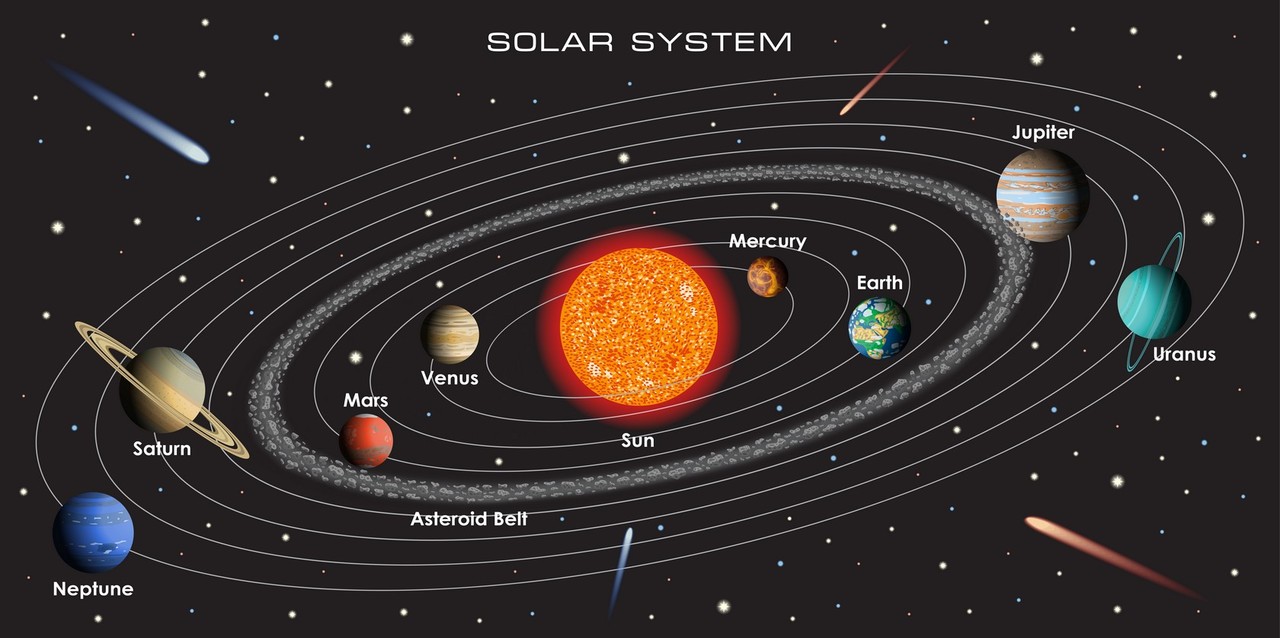 The solar system.
The solar system is held in place by Sun's gravity. The planets orbit around the Sun at a speed that is in balance with the attractive force of the Sun. This prevents them from escaping out into space and from "sinking" towards the solar system's central star.
The Sun radiates heat and light into the solar system. The Sun's radiation is produced in nuclear reactions that take place near its core. In these fusion reactions, four light hydrogen atoms are joined together in order to form a heavier helium atom. These reactions produce large amounts of energy. The Sun will continue producing energy in this manner for at least the next 5 000 million years.
The solar system also includes all kinds of other objects: planets, asteroids, moons, meteoroids and comets.
The solar system.