
32. Force
Forces
 Forces can be divided into two categories: contact forces and remote forces.
 When kicking a football, the force that makes the ball move is a contact force. The force changes the direction and speed of the ball. For a small while, it also slightly changes the ball's shape.
Friction is a type of force that prevents the movement of two touching things. The amount of friction varies.
For example, there is less friction between your shoes and the street that you walk on than there is between ice and a skate's blade,
The attractive force between the Earth and the Moon is an example of a remote force. It keeps the Moon on its orbit around the Earth. The Moon, on the other hand, causes the tidal movement of the Earth's oceans.
The attractive force or gravity between the Sun and the Earth is also an example of a remote force. It keeps the Earth on its orbit around the Sun.
Another example of a remote force is a magnetic force. In the photograph below, two magnets attract one another through a thick deck of cards.
 Magnets are an example of a remote force.
 What is gravity?
 When you jump up, a force will make you fall down again. This force is known as Earth's gravity, which is an attractive force between you and the planet.
Earth's gravity can be measured with a spring scale, and its unit of measurement is a newton (N). A spring scale shows how strong the attractive force between the weight and the Earth is. The resulting measurement determines the object's weight.
Balance scales are used to measure mass. The unit of mass is the gram (g) or the kilogram (kg), which is a thousand grams.
The difference between mass and weight is that the mass of objects is constant, no matter whether you are on Earth or on the Moon. In contrast, the weight of an object can vary depending on the gravity that affects it. The attractive force between an astronaut and the Moon is smaller than that of the same person and the Earth. This is why people weigh less when they are on the Moon than they do when they are on Earth.
Movement
 Movement can be either stable or accelerating.
 Satellites are transported into space with the help of rockets. These rockets have a high accelleration, which makes it possible for them to escape Earth's gravity.
Stable movements are rare. This is because both the speed and the direction of the moving object should remain the same. On Earth, this is practically impossible.
However, the movement of a satellite is relatively stable. Otherwise, it would not be able to remain on its orbit around Earth. If its movement was accelerating, the satellite would eventually escape Earth's orbit into space. If its movement was decelerating, it would fall back down to Earth.
As a result, the speed of the satellite must be in balance with the attractive force between it and the Earth.
Balance
The balance between Earth and the Moon is stable.
In the photograph below, you can see an example of stable and unstable balances. The balance of the lowest rock is stable, as it will not fall down when pushed. The balance of the highest rocks, on the other hand, is unstable. Even a small touch can make them move and fall.

Each object has its own center of gravity. As long as the center of gravity remains on top of the supporting surface, the object remains in good balance and will not fall down. When the center of gravity moves outside the supporting surface, the object becomes unstable. Eventually, it will fall down.

A wooden object falls down from a slanted metal surface when its center of gravity (the black string) moves outside its supporting surface.
Magnetic force
 A magnet is surrounded by a magnetic field. The magnetic field travels around the magnet, between its two poles.
In the picture on the right, iron dust has been used to show the magnet's force lines. These force lines comprise the magnet's magnetic field.
Planet Earth has its own magnetic field. It surrounds planet Earth, consisting of force lines that travel between the planet's two poles.
The needle of a compass is a small magnet that reacts with Earth's magnetic field. The needle always orients itself in a way where it points towards the northern and southern poles of the planet's magnetic field.
Many kinds of things can affect an object's magnetic field. One of these factors is heat, which can remove an object's magnetism. Usually, a temperature of over 80 degrees Celsius is enough. Magnetism can also be removed by striking the magnet on different objects.
The poles of a magnet
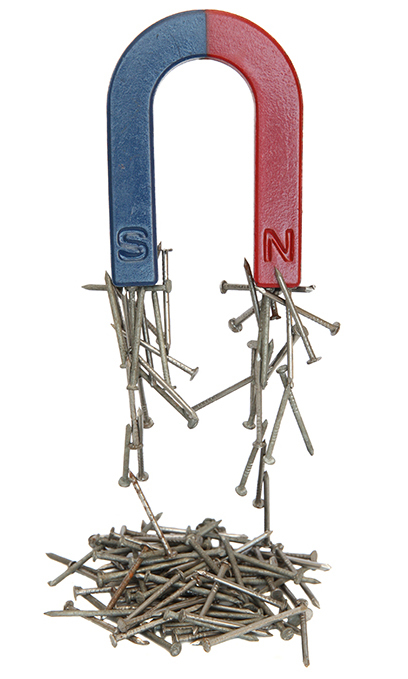
A magnet contains two poles: a south pole and a north pole.
Different poles attract each other strongly.
If a magnet is cut in two, the result is two smaller magnets, both of which have their own south and north poles.
Various metals, such as iron, nickel and kobolt, are magnetic. They form a strong magnetic force when a magnet is brought near them.
The similar poles of two magnets repel one another strongly. This is why strong magnets are hard to place next to one another.
Planet Earth is a magnet
Planet Earth also acts as a large magnet.
The electric currents in the planet's core maintain the planet's magnetic field or magnetosphere. It is similar to that of a regular bar magnet.
The planet's magnetosphere protects us from harmful solar winds. Near the planet's two poles, some solar winds can penetrate the magnetosphere, creating the northern lights.
Solar wind also modifies the planet's magnetic field.
 The Earth's magnetosphere protects us from solar wind.
Terminology
| Term | Explanation |
|---|---|
| friction | A force that resists the movement of two touching objects. |
| gravity | An attractive force between objects and the Earth. |