
34. The solar system
Stars and constellations
 Our solar system is located inside the star system or galaxy we call the Milky Way. At night, we can see many of the galaxy's other stars with our bare eyes. Like the Sun, these stars are large, hot objects that consist of gas and produce radiation in fusion reactions.
The stars of the night sky are divided into constellations. This makes finding different stars and planets easier.
Even though the stars of different constellations appear to be close together when viewed from the Earth, they can actually be very far from one another. Often, the stars of a constellation have nothing in common with one another except for the fact that they are perceived to be close to one another when viewed from planet Earth.
The solar system
The solar system is held in place by Sun's gravity. The planets orbit around the Sun at a speed that is in balance with the attractive force of the Sun. This prevents them from escaping out into space and from "sinking" towards the solar system's central star.
The Sun radiates heat and light into the solar system. The Sun's radiation is produced in nuclear reactions that take place near its core. In these fusion reactions, four light hydrogen atoms are joined together in order to form a heavier helium atom. These reactions produce large amounts of energy. The Sun will continue producing energy in this manner for at least the next 5 000 million years.
The solar system also includes all kinds of other objects: planets, asteroids, moons, meteoroids and comets.
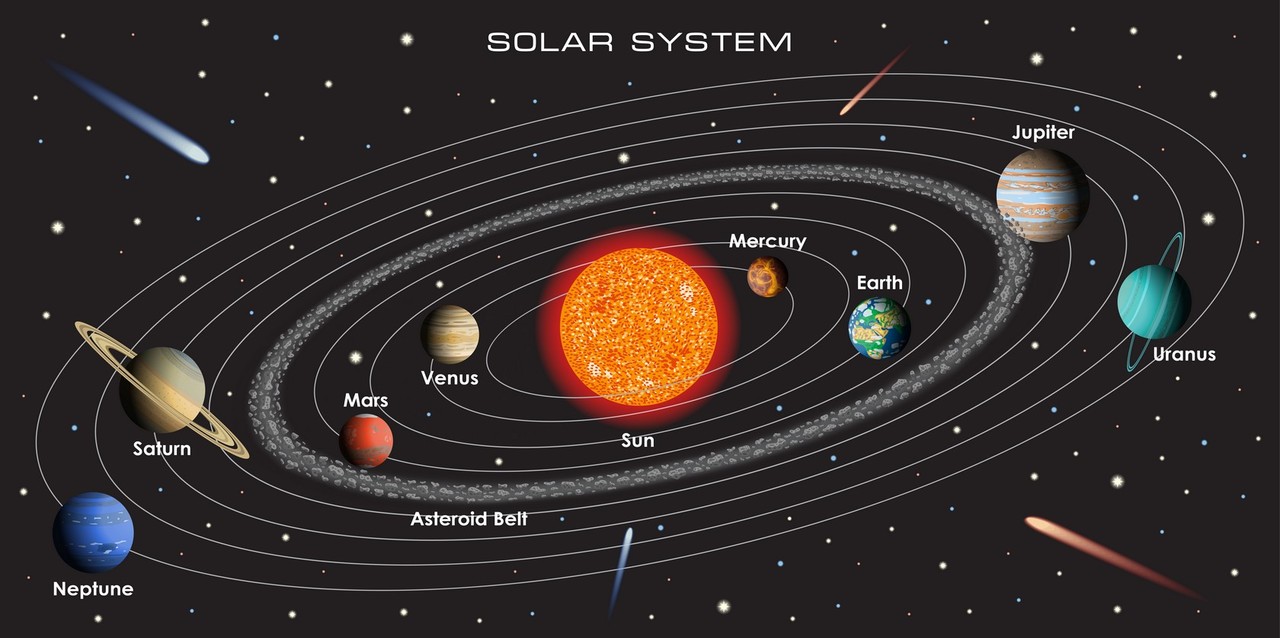 The solar system.
The rocky planets
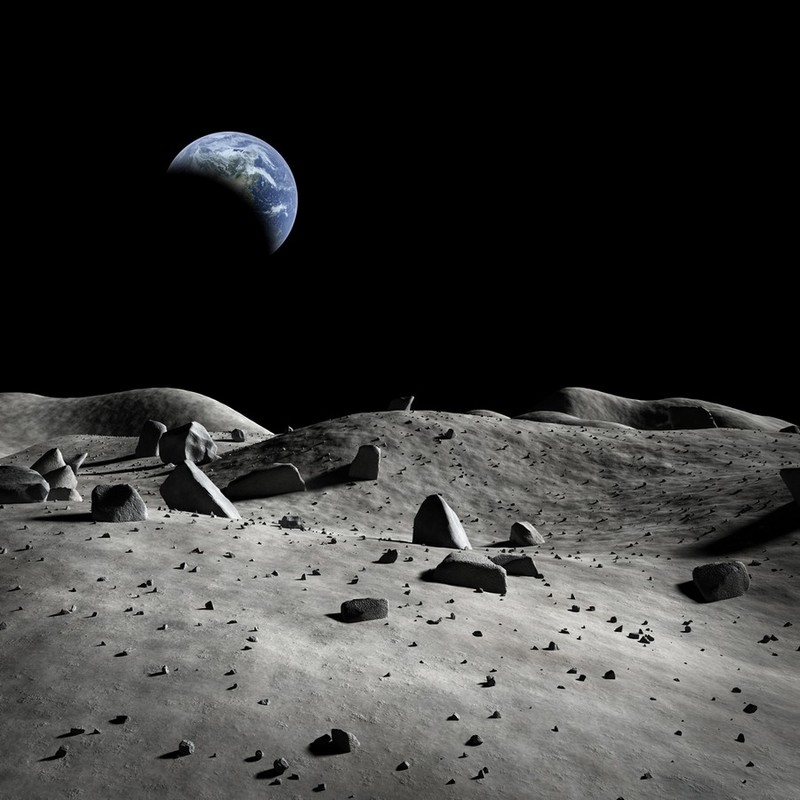 The planets of our solar system are large objects that orbit around the Sun. Although the may look like stars when viewed from the Earth, they do not produce light themselves. Instead, they reflect the Sun's light back towards us.
 Some planets have satellites known as moons.
The four planets located closest to the Sun are rocky planets.
The planet closest to the Sun is called Mercury.
Venus is located between Mercury and Earth.
The third planet from the Sun is our planet, Earth. It is located at a perfect distance from the Sun in terms of supporting light: it is not too close (which would result in extremely high temperatures) or too far away (which would result in extremely cold temperatures).
The fourth rocky planet of the solar system is our neighbor Mars.
 Mercury, Venus, Earth and Mars are all rocky planets.
The asteroid belt
 Between Mars and Jupiter, we can find a large number of smaller rocks orbiting the Sun. The largest of these rocks are known as asteroids, whereas the smallest are called meteoroids.
 If a meteoroid travels to Earth and enters the planet's atmosphere, the air's friction will make it heat up and burn into a crisp. When this happens, the meteoroid can be seen in the form of a meteor or a shooting star. If the meteoroid is so large that it reaches the surface of the planet, it is considered a meteorite.
When a meteorite or asteroid hits the planet's surface, the resulting impact is extremely strong. These impacts have created the craters we can see in different parts of the world today. It is also thought that an asteroid that hit the Earth over 60 million years ago was behind the extinction of the dinosaurs.
The gas planets
Behind the asteroid belt, the Sun is orbited by four large gas planets. These planets have no rocky surfaces.
The largest gas planet of our solar system is Jupiter. It has 63 moons.
Behind Jupiter, we can find the gas planet Saturn, which is known for its rings.
Uranus is the third gas planet in the solar system. Neptune is the outermost gas planet of the solar system. It cannot be seen from the Earth with the naked eye.

The four large gas planets are Jupiter, Saturn, Uranus and Neptune.
The outer zone of the solar system
Comets come from the Kuiper zone. When a comet travels towards the Sun, it will form a large tail of dust and gas. The comet travels around the Sun and continues its movement towards the outer reaches of the solar system. One of these journeys can take up to thousands of years.
 A comet.