
1 My values
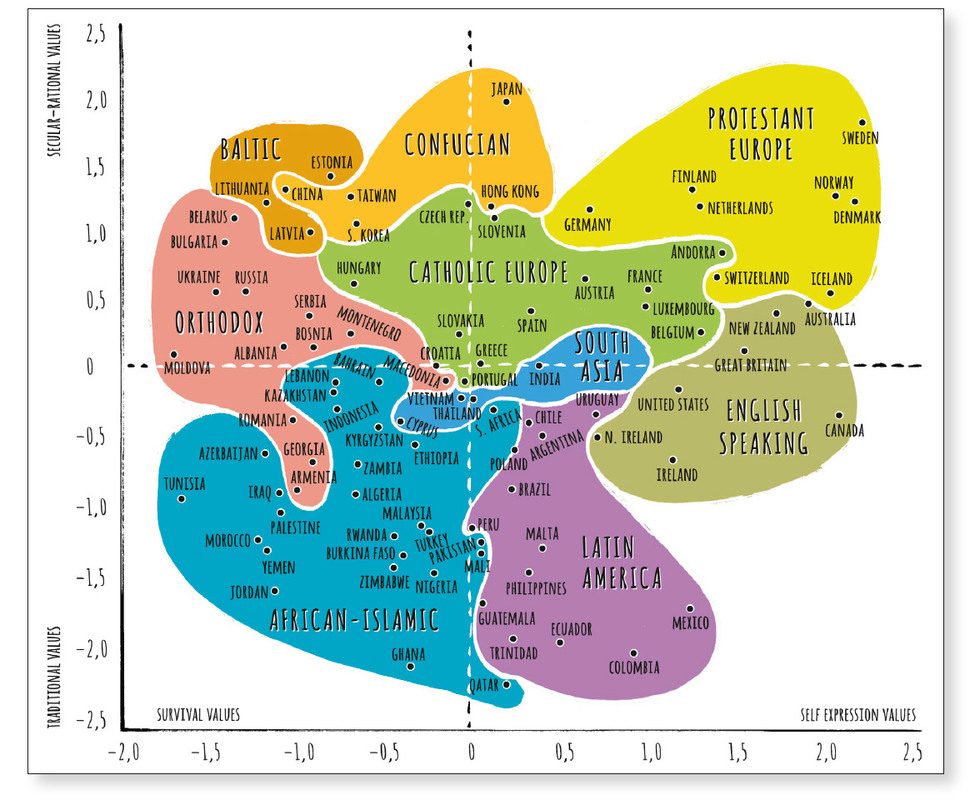
What the world values
-
What do different societies value?
-
Where do those values come from?
-
How do different social circumstances, like religion, economic systems, war and peace, shape values for a society?
-
What values result in a more democratic, rights-oriented society?
These are some of the questions that led professors Ronald Inglehart and Christian Welzel to create a cultural map of the world.
The map charts how values compare across nine different clusters (English-speaking, Catholic Europe, Protestant Europe, African-Islamic, Confucian, Orthodox, Latin America, Baltic and South Asia). The y- and x-axes represent different values from traditional values to secular-rational values on the y-axis and from survival values to self-expression values on the x-axis.
What do these values mean?
Traditional values emphasize religion, traditional family values, parent-child ties and national identity.
Secular-rational values emphasize individual decision-making and a lack of absolute moral standards.
Survival values prioritize economic and physical security with a distrust of individuals, especially those who represent a change in values.
Self-expression values give high priority to self-expression, individual quality of life and tolerance.
A
Take a closer look at the chart and discuss the following questions in small groups.
-
Which nationalities are closest to Finns on this map?
-
How different are the values of the Nordic countries from each other?
-
How different are values between European countries?
-
Which European countries have the biggest differences between them?
-
In what ways are values different in Finland and Russia?
-
In what ways are Finns different from people living in North America?
-
Do people in rich countries have different values to the ones living in less wealthy ones? Give reasons for your answer.
-
Do you see any problems or issues with the chart? Explain.
B
In your group, imagine you are researchers getting more data for the Values map. For each value set, write 2–3 questions that would allow you to see how well someone fits those values.
C
Many factors might affect your values. Rank these factors from the most important to the least important in your opinion. Share them with the rest of your group and explain why you chose your top three.