
32. Levers
First class levers
 A lever is a simple device or machine. It can be used to gain a mechanical advantage. Levers are found in all kinds of places.
The first class lever is also known as a rocker arm. When one end of the lever is pressed, the other end of the lever rises. The force and the load move in different directions. The fulcrum, or the part of the lever that provides it with support, is located at the center of the lever.
Pressing a first class lever requires a broad hand movement, but it also requires less force. The closer the load is to the fulcrum and the longer the lever is, the easier it is to lift the load.
A rocker arm is useful for twisting containers and cans open. Bottle openers also make use of the first class lever.
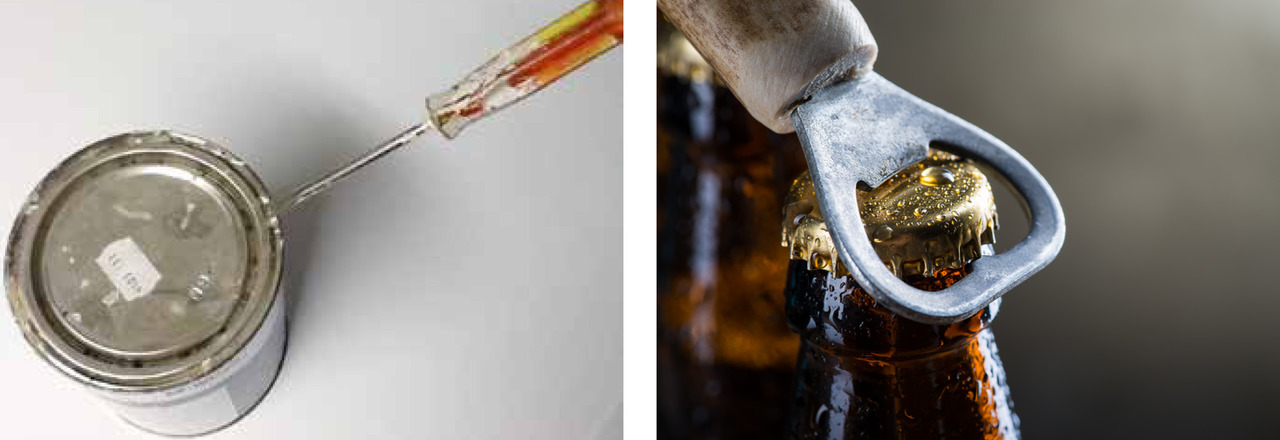
A rocker arm is useful for opening various containers.
Soda cans are also opened with small first class levers. The force of your fingers lifts one end of the lever. The rivet at the center of the opener acts as the fulcrum. The other end of the lever is pressed downwards and opens the can.
If a glass jar contains a vacuum, it may be hard to open. This is when a rocker arm becomes useful. It can be used to lift the lid of the jar so that air is able to fill the jar. After this, the jar is easier to open.

Image on the left: Soda cans are opened with simple first class levers. Image on the right: If a glass jar contains a vacuum, the lid can be opened with the help of a rocker arm.
The see-saws found in playgrounds are also first-class levers. The function of old draw-wells also makes use of a rocker arm.

See-saws and draw-wells are examples of first class levers.
Second class levers
 In second class levers, the hand movement is increased, but the amount of energy required is decreased. The force and the load move in the same direction.
Like first class levers, second class levers are also more functional when the fulcrum and the load are located close together and when the lever itself is longer.
Bottle openers are usually levers. They can be used like first class levers, but also as second class levers. When using a bottle opener as a second class lever, the hand and the bottle cap move in the same direction.
The egg cutter is also an example of a second class lever. The fulcrum is located at the end of the lever, and the load is provided by the egg. The hand and the cutter move in the same direction.
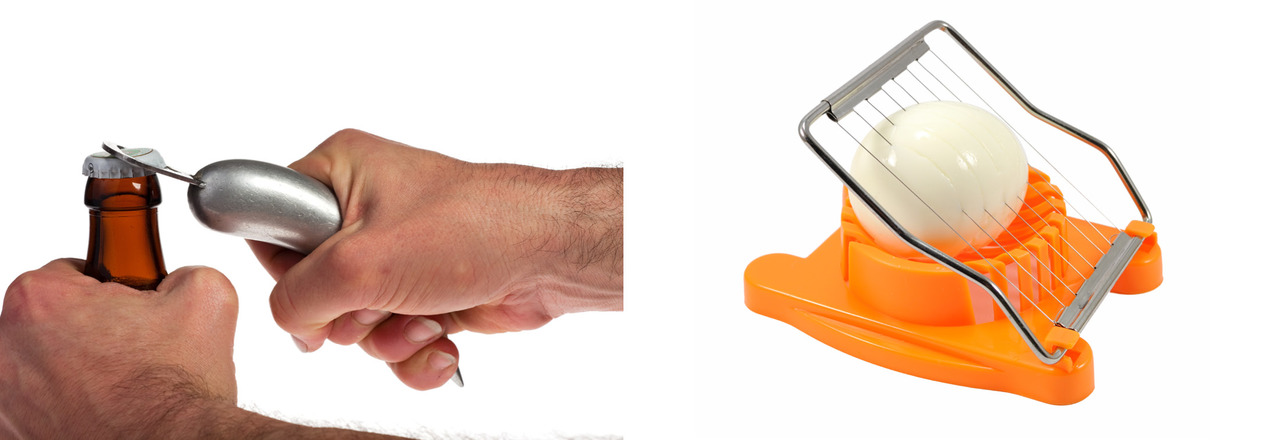
Bottle openers and egg cutters are examples of second class levers.
The hand brake of a bicycle is also a lever. The load is provided by the brake cable. Because the load is located between the hand and the fulcrum, the hand brake is an example of a second class lever.
A hole punch is also a second class lever. Its fulcrum is located at the end of the lever. The hand pressing the lever moves in the same direction with the sharp edges that press holes in the paper.
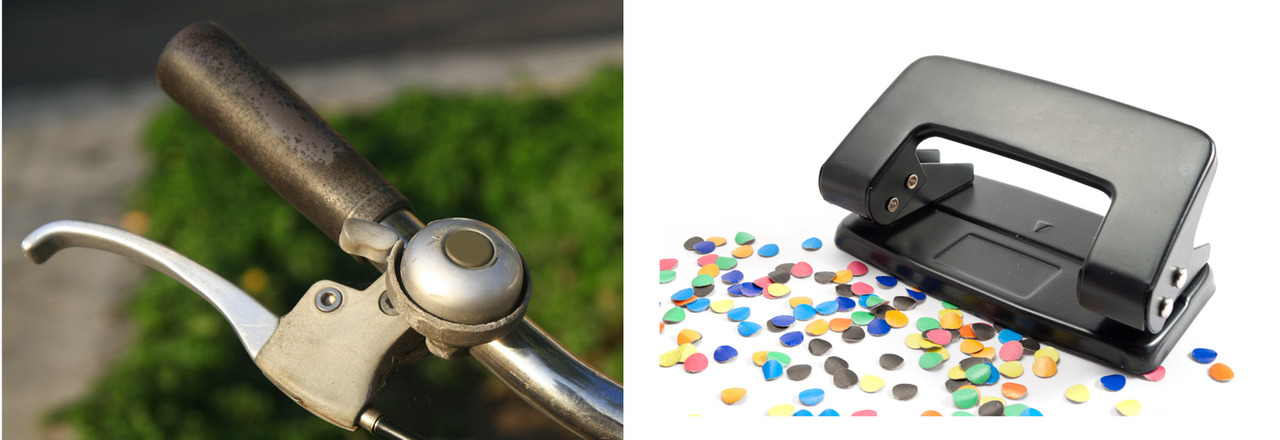
Hand brakes and hole punches are also second class levers.
The trigger of a fire extinguisher is also a second class lever. The fulcrum is located at the end of the lever, whereas the load is provided by a peg that opens the extinguisher's valve.
The railing of a loom is also an example of a seond class lever. It is used to compress threads when weaving a textile.

The trigger of a fire extinguisher and the railing of a loom are also examples of the second class lever.
Third class levers
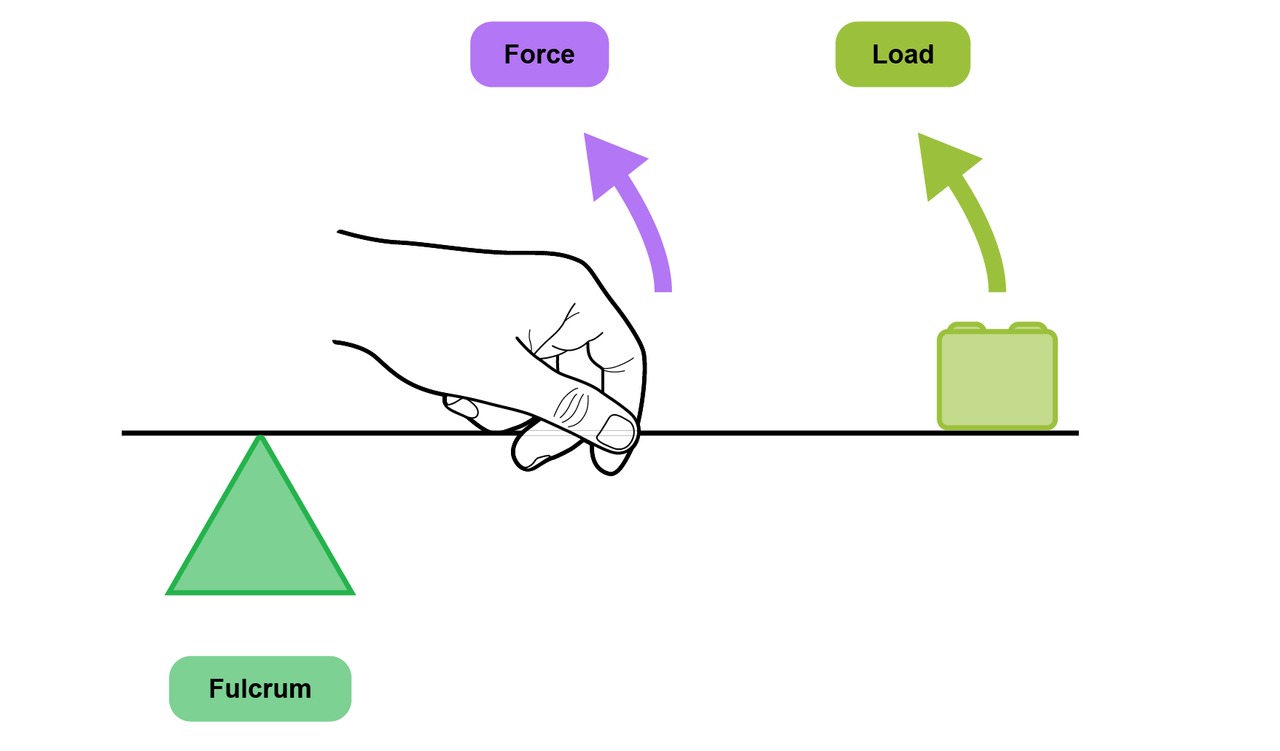 In third class levers, a small movement produces a large movement at the edge of the lever. The force moves between the fulcrum and the load.
Third class levers do not make lifting a load easier. Instead, they produce large movements with small amounts of force.
The arm is an example of a third class lever. The small movements of the muscles make the arm move for longer distances.
Third class levers are useful for throwing things.

Image on the left: The arm of the pitcher makes use of a third class lever. On the right: A ball can be made to travel a longer distance by extending the arm with a plastic thrower.
A fishing rod is an example of a third class lever. The fulcrum is located in the fisher's belt, the left hand produces the force, and the load is provided by a large fish.
A floorball stick is also an example of a third class lever. The force is located at the center of the level, whereas the fulcrum is found at its upper end. A small movement makes the ball travel with great force and speed.

Fishing rods and floorball sticks are examples of third class levers.
Terminology
| Term | Explanation |
|---|---|
| lever | A simple device that is used to produce large forces with only a little energy. |
| first class lever | A lever with a fulcrum located at its center. E.g. a see-saw. |
| second class lever | A lever with a fulcrum located at its end. E.g. a hand brake. |
| third class lever | A lever where the force is applied between the fulcrum and the load. E.g. a fishing rod. |