
20.1 Genes contain hereditary information
Children inherit traits from their parents. More specifically, traits themselves are not inherited, but the genes that provide the traits are. A certain piece of DNA strand makes up a gene. There are thousands of genes in each chromosome. In total, humans are estimated to have more than 20,000 genes. The exact figure is still unknown.
People usually have two copies of each chromosome. One copy is inherited from their mother (via the egg) and the other from their father (via the sperm).
There are two forms of each gene, one located in the chromosome inherited from the father and the other in the chromosome inherited from the mother. These gene forms may be the same or different from each other. Changes (or variations) in the gene for that characteristic cause different kinds of gene forms. Each variation of a gene is called an allele. The two alleles that form a gene pair are inherited, with one allele coming from each parent. Alleles interact with each other in different ways. These two copies of the gene contained in your chromosomes influence the way your cells work.
If an individual inherits completely identical alleles that affect a particular trait from his parents, the individual is said to be homozygous for that trait. If, on the other hand, the gene forms or alleles inherited from the parents are different from each other, the individual is considered heterozygous in terms of the trait. The location of each gene in a chromosome is called a locus.
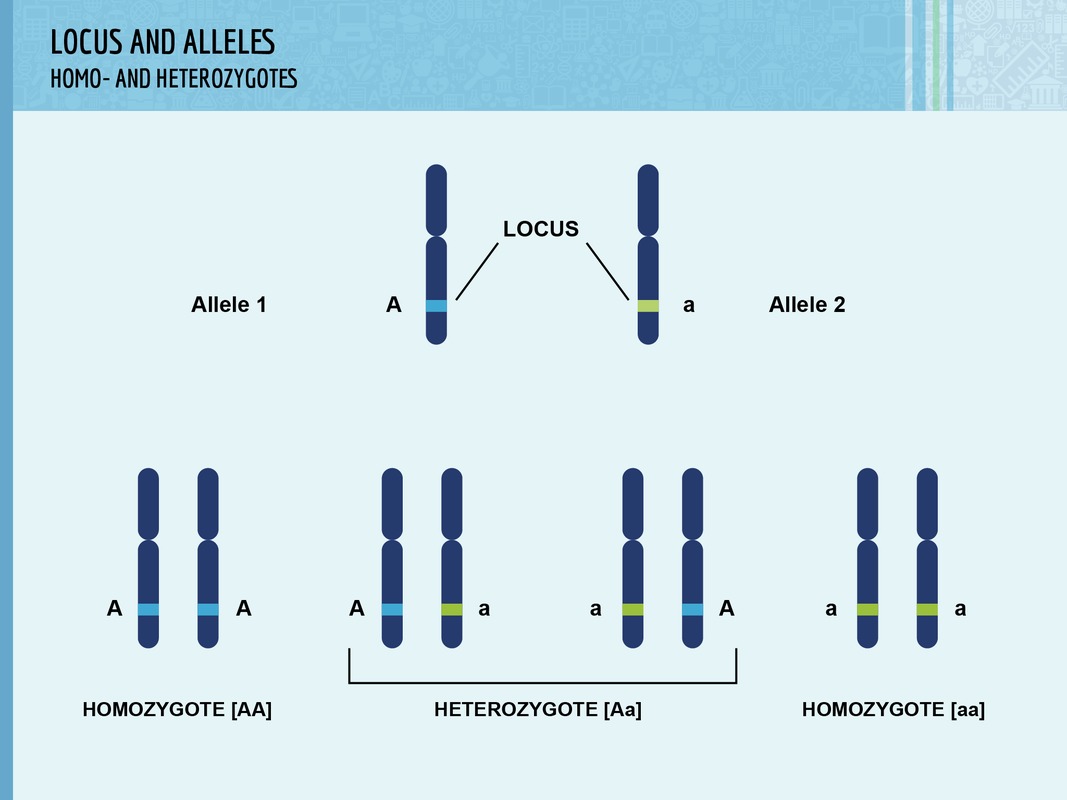 A cell has two copies of a chromosome. If they are carrying the same allele (same variety of the gene) then they are homozygous for that gene. If they are different, the chromosome pair is heterozygous.