
14.3 The anatomy of the human eye
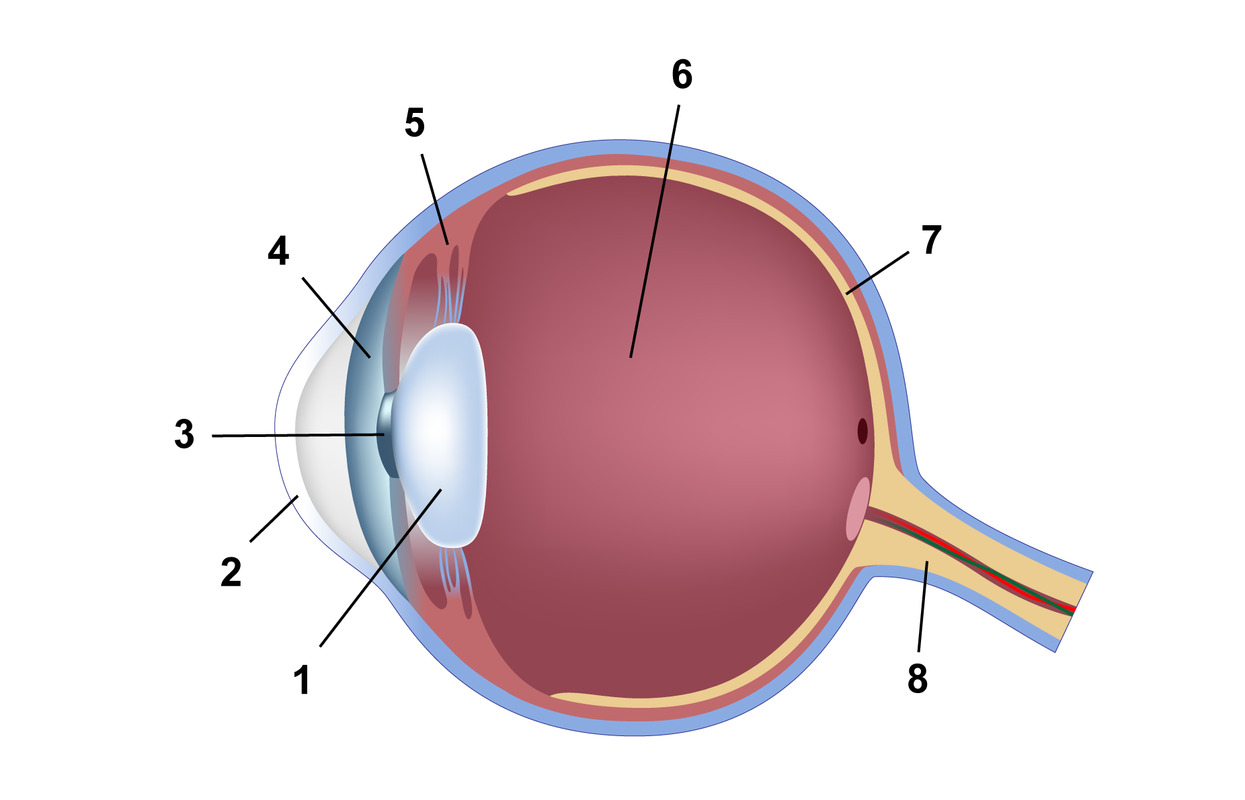 The human eye is protected by a light-transmitting and refracting cornea (2).
The iris (4) is located beneath the cornea. The iris regulates the size of the pupil. The colour of the iris varies from brown to light grey. Only a percentually small segment of people have blue irises.
The lens (1) is located under the iris. The lens refracts light strongly. The ciliary muscle (5), part of the ciliary body, controls the shape of the lens.
The pupil (3) is located at the center of the lens. It is the opening in the middle of the iris.
The vitreous body (6) consists of a gel-like liquid that fills the eye.
The retina (7) is found at the very back of the eye. Light-sensing neurons are located on its surface. The retinal nerve cells consume a lot of energy and oxygen, which is why there is a choroid behind the retina, the tiny capillaries of which bring sugar and oxygen into place.
The axons of the retinal neurons form the optic nerve (8). One optic nerve connects each eye to the brain. The choroid is the vascular layer of the eye that lies between the retina and the sclera.
Each of our eyes has a tiny functional blind spot about the size of a pinhead. In this tiny area, where the optic nerve passes through the surface of the retina, there are no light-detecting photoreceptor cells. Since there are no photoreceptor cells in this spot, the result is a blind spot. Without photoreceptor cells, the eye cannot send any messages about the image to the brain, which usually interprets the image for us. However, the brain connects information from both eyes, which is why we don’t notice the “blind spot” in our retinas.