Question 4: Discuss the claim that development in industrializing countries often violates universal rights to a clean environment and to the humanitarian treatment of labour.
[Unit of study: Human rights]
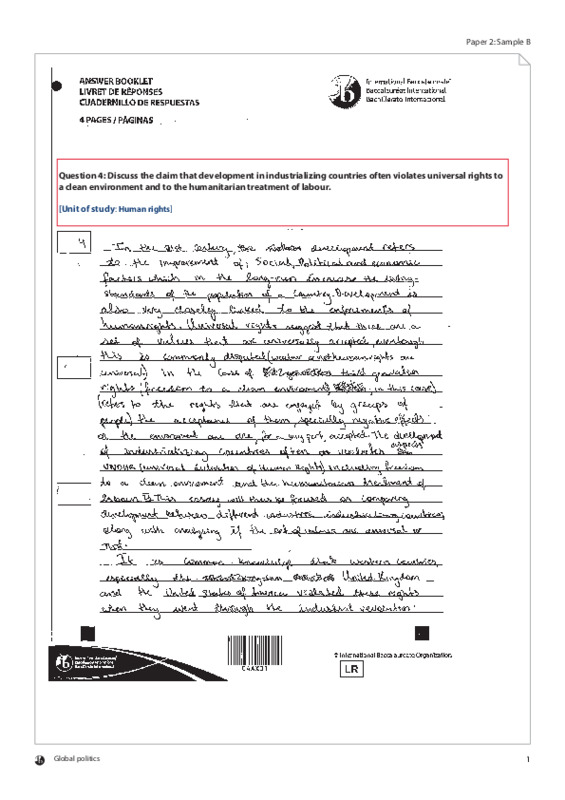
A rather good response to the question but one that does not fulfill its initial promise. The candidate commences strongly by noting that most, if not all, of the current industrialized states violated environmental and/or labour standards to reach their industrialized state. The implication here is that there is a certain degree of hypocrisy involved in developed states now attempting to deny (or at the very least, to criticize) developing states the same experience/trajectory. This was a rather nuanced start to the paper. However, the candidate then suddenly shifts focus to a discussion of some of the ways industrializing states have historically violated, and continue to violate, such rights in an effort to encourage economic growth/industrialization. While the analysis that ensues is good (in some respects more than others), one feels that an opportunity was missed here to engage in some sophisticated analysis and evaluation. There is a strange and descriptive mention of how the presence of inequality in all countries guarantees that rights are being violated, but there are no real-world examples in support of this assertion. A counterclaim is offered, but the argument that labour rights are not being violated in ASEAN states was extremely weak for a host of reasons, not least of which is that ASEAN’s own human rights declaration directly affirms all of the civil, economic, social, cultural and political rights in the UDHR. Despite this criticism, this remains a strong response and there was certainly enough to warrant a mark in the lower range of the 16–20 markband.

Kommentit
Question 4: Discuss the claim that development in industrializing countries often violates universal rights to a clean environment and to the humanitarian treatment of labour.
[Unit of study: Human rights]
A rather good response to the question but one that does not fulfill its initial promise. The candidate commences strongly by noting that most, if not all, of the current industrialized states violated environmental and/or labour standards to reach their industrialized state. The implication here is that there is a certain degree of hypocrisy involved in developed states now attempting to deny (or at the very least, to criticize) developing states the same experience/trajectory. This was a rather nuanced start to the paper. However, the candidate then suddenly shifts focus to a discussion of some of the ways industrializing states have historically violated, and continue to violate, such rights in an effort to encourage economic growth/industrialization. While the analysis that ensues is good (in some respects more than others), one feels that an opportunity was missed here to engage in some sophisticated analysis and evaluation. There is a strange and descriptive mention of how the presence of inequality in all countries guarantees that rights are being violated, but there are no real-world examples in support of this assertion. A counterclaim is offered, but the argument that labour rights are not being violated in ASEAN states was extremely weak for a host of reasons, not least of which is that ASEAN’s own human rights declaration directly affirms all of the civil, economic, social, cultural and political rights in the UDHR. Despite this criticism, this remains a strong response and there was certainly enough to warrant a mark in the lower range of the 16–20 markband.
Kirjaudu sisään lisätäksesi tähän kommentin