
Applying to a university and choosing the correct register
Monday: Register: How formal/informal language should you use?
https://www.learn-english-today.com/vocabulary/formal-informal-expressions.html
"Formal English expressions are used in formal letters or in situations involving people you do not know very well. The tone is respectful and polite."
"Informal English expressions are used in everyday conversations and emails exchanged with friends, colleagues or people you know well. The tone is casual and friendly."
"Formal English expressions are used in formal letters or in situations involving people you do not know very well. The tone is respectful and polite."
"Informal English expressions are used in everyday conversations and emails exchanged with friends, colleagues or people you know well. The tone is casual and friendly."
Monday
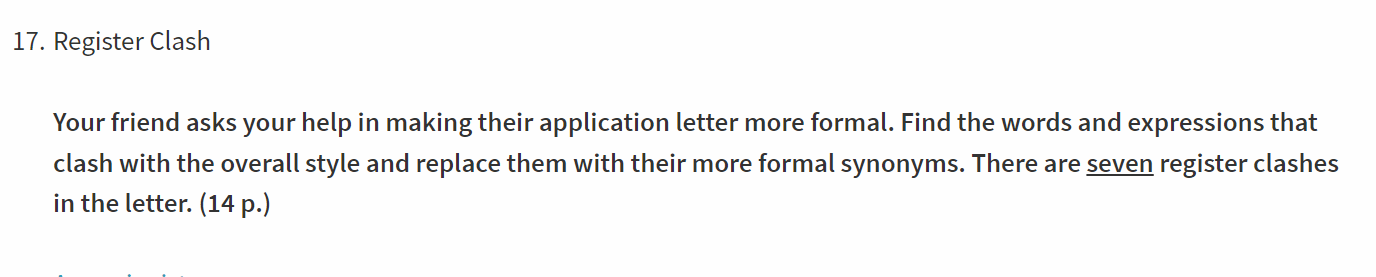
Monday
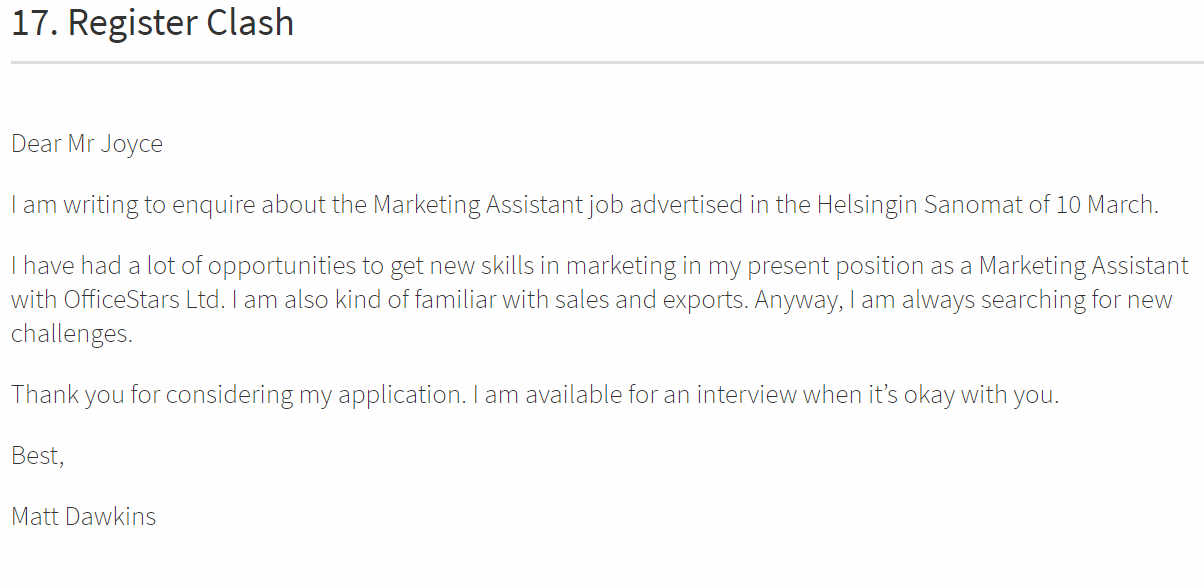
Monday 11.4 : Writing a formal email: ex 3e
1Choose a college/university. You may use the links on the right. The web-page doesn´t give you enough information so you decide to contact the admissions office and send them an email.
Write an email:
Remember the correct register: no spoken language!
Use friendly and polite language
Start with :
Dear sir/madam (in formal documents: To whom it may concern)
Conditional
Could/ Would/ Might
Indirect questions / grammar 2.2
I was wondering if you could... I would like to know when I should ... Could you tell me if I have to...
Kirjan Grammar-osiossa:
Grammarissa myös:
Make use of Glossary: education
Close with:
Sincerely
Plan carefully, (list everything you want to ask and mention), use varied vocabulary and grammar, avoid repeating words and phrases, check grammar and spelling, remember capital letters and punctuation (= isot alkukirjaimet ja välimerkit)
150-250 words (700-1300 characters)
And finally: use your imagination!!
Write an email:
Remember the correct register: no spoken language!
Use friendly and polite language
Start with :
Dear sir/madam (in formal documents: To whom it may concern)
Conditional
Could/ Would/ Might
Indirect questions / grammar 2.2
I was wondering if you could... I would like to know when I should ... Could you tell me if I have to...
Kirjan Grammar-osiossa:
| rakenteita, joita johtolauseissa käytetään yleisesti. | |
|---|---|
| know | have no idea |
| would like to know | wonder |
| do you know | can’t/couldn’t understand |
| want to know | can’t/couldn’t remember/recall |
| don’t know | inquire/enquire |
Grammarissa myös:
| Yhdessä virkkeessä käytetään yleensä joko nykyhetken muotoja tai menneen ajan muotoja. | |
|---|---|
|
NYKYHETKEN MUOTOJA
|
MENNEEN AJAN MUOTOJA
|
| futuuri | imperfekti |
| perfekti | konditionaali |
| preesens | pluskvamperfekti |
Make use of Glossary: education
Close with:
Sincerely
Plan carefully, (list everything you want to ask and mention), use varied vocabulary and grammar, avoid repeating words and phrases, check grammar and spelling, remember capital letters and punctuation (= isot alkukirjaimet ja välimerkit)
150-250 words (700-1300 characters)
And finally: use your imagination!!