
Sources of electricity
Chemical energy is caused by the chemical difference between two metals. Chemical energy can be converted into electricity. This can be done when connecting sheets of zinc (Zn) and copper (Cu) into an electric circuit. They only need a substance that can conduct their electricity, which can even be as simple as a glass of salt water or a potato. When the two metals are connected together, a chemical reaction begins to take place. The zinc and copper sheets form an electric pair, which has an electric tension of approximately one volt.
The world's first battery was made with metal discs that were separated with a paper that had been placed in salt water. The diagram below shows a similar system with six electric pairs. Together, the electric pairs produce an electric tension of approximately six volts.
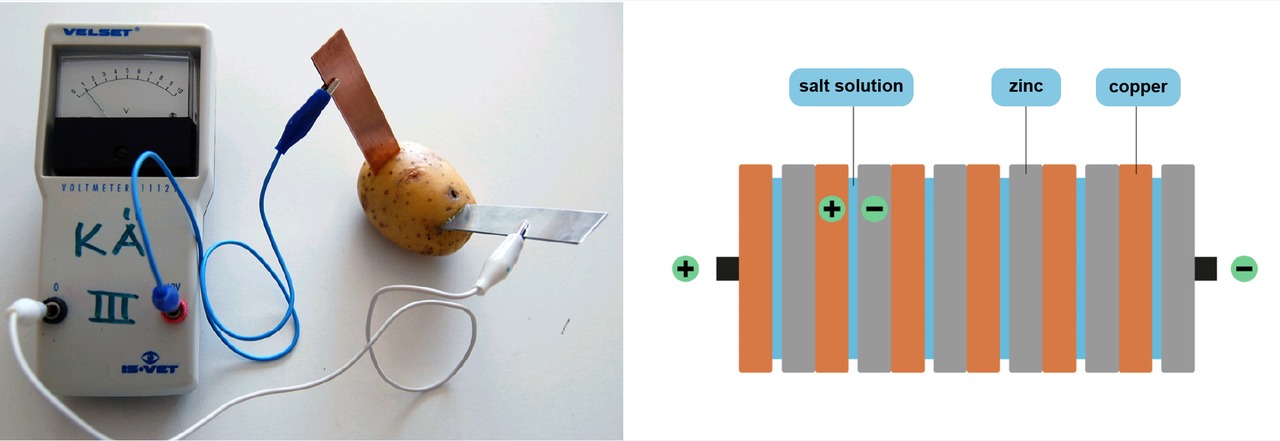
On the left: When two different metals are connected with a conductor (e.g. a potato), they form an electric pair. On the right: Chemical energy is caused by the chemical difference between two metals. The metals form an electric pair, which can be used to power an electric circuit.
- Modern electric pairs form an electric tension of 1,5 volts.
- A flat battery contains three electric pairs, resulting in a tension of 1,5 x 3 = 4,5 volts.
- A 9-volt battery contains six electric pairs, resulting in a tension 6 x 1,5 = 9 volts.
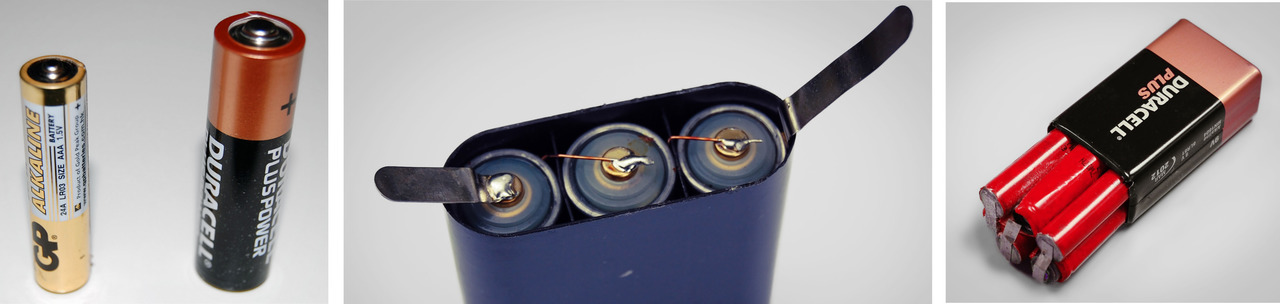
On the right: A 1,5-volt battery contains a single electric pair. In the middle: A flat battery contains three electric pairs, which means that it has a tension of 4,5 volts. On the right: A 9-volt battery contains six electric pairs.