
13. Converting energy into electricity
Sources of electricity
Chemical energy is caused by the chemical difference between two metals. Chemical energy can be converted into electricity. This can be done when connecting sheets of zinc (Zn) and copper (Cu) into an electric circuit. They only need a substance that can conduct their electricity, which can even be as simple as a glass of salt water or a potato. When the two metals are connected together, a chemical reaction begins to take place. The zinc and copper sheets form an electric pair, which has an electric tension of approximately one volt.
The world's first battery was made with metal discs that were separated with a paper that had been placed in salt water. The diagram below shows a similar system with six electric pairs. Together, the electric pairs produce an electric tension of approximately six volts.
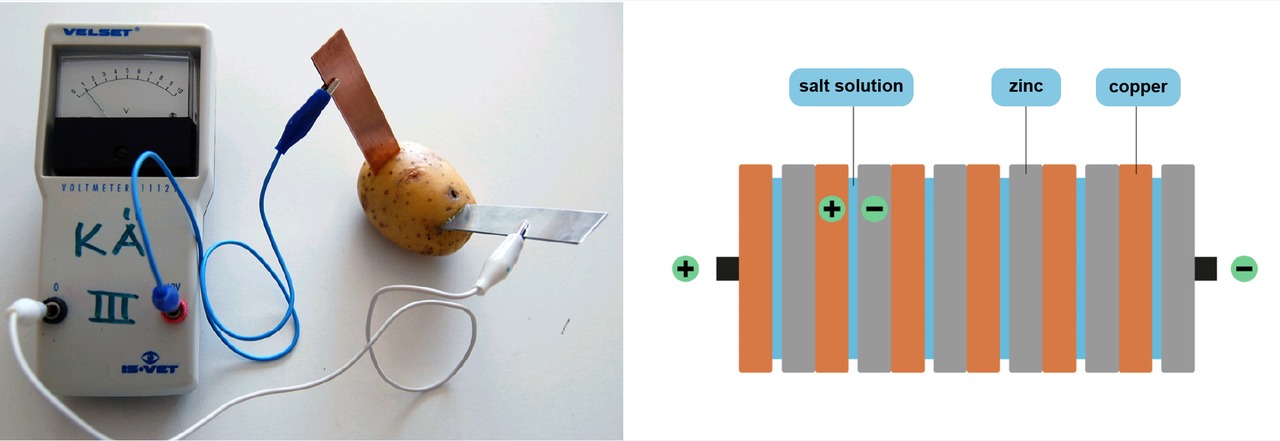
On the left: When two different metals are connected with a conductor (e.g. a potato), they form an electric pair. On the right: Chemical energy is caused by the chemical difference between two metals. The metals form an electric pair, which can be used to power an electric circuit.
- Modern electric pairs form an electric tension of 1,5 volts.
- A flat battery contains three electric pairs, resulting in a tension of 1,5 x 3 = 4,5 volts.
- A 9-volt battery contains six electric pairs, resulting in a tension 6 x 1,5 = 9 volts.
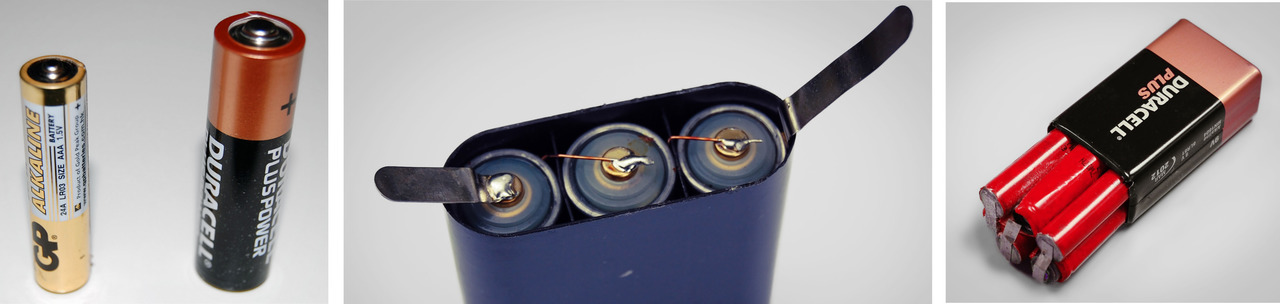
On the right: A 1,5-volt battery contains a single electric pair. In the middle: A flat battery contains three electric pairs, which means that it has a tension of 4,5 volts. On the right: A 9-volt battery contains six electric pairs.
Converting energy into electricity
Movement energy can also be converted into electricity. When a magnet is moved near a coil made of copper wire, the result is electric energy. The image below shows a cross-section image of a flashlight that uses this kind of a swinging generator as its source of electricity. The magnet moves back and forth through the coil of copper wire. The lamp also contains a small unit that stores electric tension, which means that it does not have to be swinged constantly to produce light. An LED lamp serves as the flashlight's light source.
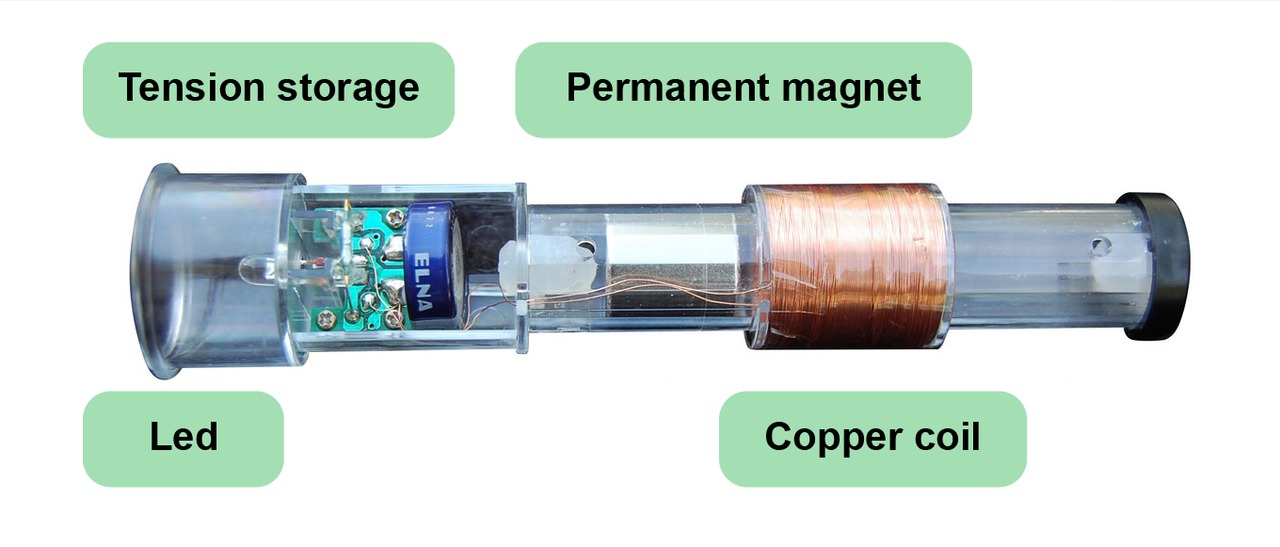
A flashlight that uses a swinging generator as its source of electricity.
 Most often, the generator is not swung but rotated. The flashlight on the right is powered by a crank generator. The flashlight produces light only when the crank is rotated, because it does not contain a tension storage unit.
When a generator is connected to a rotor, the flow of water, air or water vapor can also be converted into electricity.
In the images below, you can see two types of rotor generators. The rotor rotates the electric motor that functions as a generator. As a result of this, the movement energy of flowing air or water can be converted into electricity.
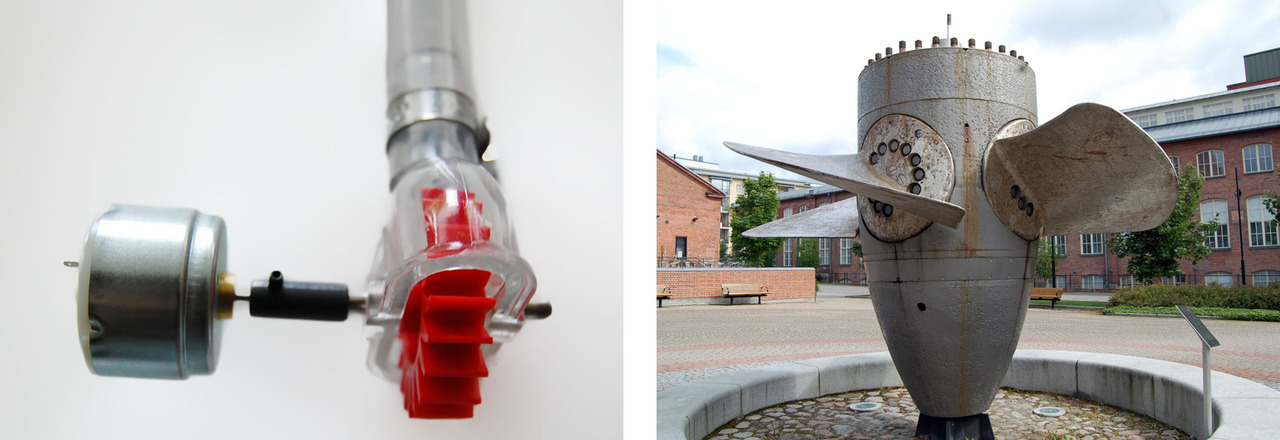
On the left: A small rotor that rotates an electric motor. On the right: A rotor of an old waterpower plant.
Large wind power generators or windmills have rotors with three long blades.
The rotors of vapor power plants are complex and therefore extremely powerful. Water vapor can be released by boiling water in large containers. The water can be set to boil by burning a fuel, such as coal, oil or peat. In nuclear power plants, water vapor is produced by splitting the cores of atoms in nuclear fission reactions.
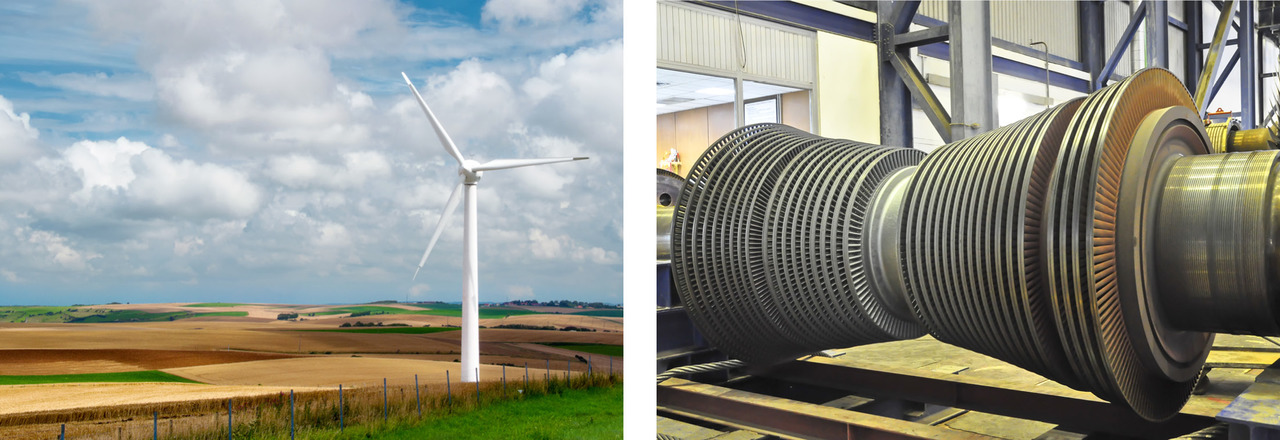
On the left: The rotors of wind power generators or windmills contain three long blades. On the right: The complex rotor of a vapor power plant is rotated by the pressure of water vapor.
Sunlight can also be converted into electricity. To do this, we need a photoelectric cell, which contains two different forms of silicon (Si). These photoelectric cells are then connected together to form large, flat panels. Solar panels can be placed on the roof of a house, for example. They serve as sources of tension in electric circuits. They are often used in places that are not reached by large power grids, such as summer houses or distant islands.
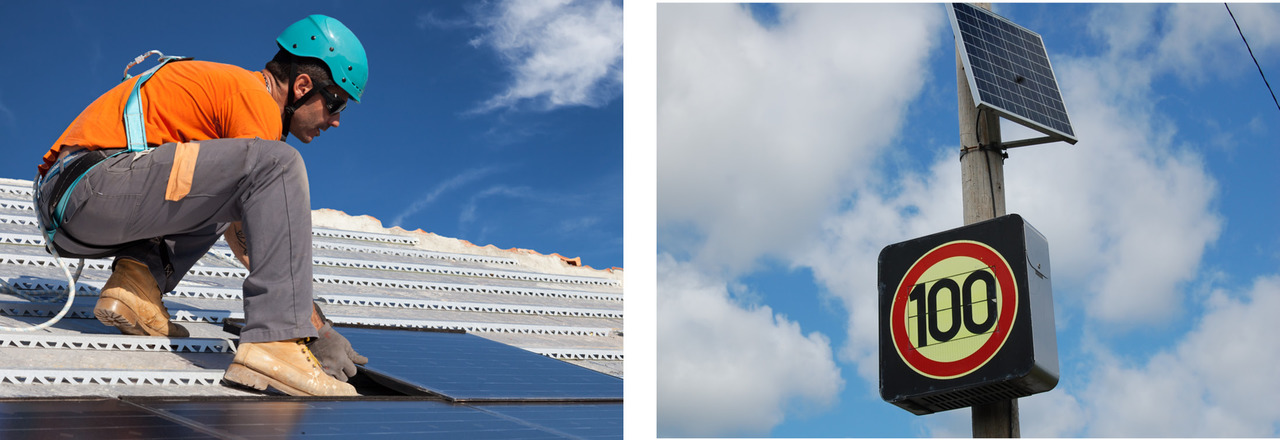
On the left: Solar panels being installed on a roof. On the right: An electronic traffic sign that is powered by a solar panel.
Terminology
| Term | Explanation |
|---|---|
| chemical energy | A form of energy produced as the result of a chemical difference between two metals. Batteries are sources of chemical energy. |
| movement energy | The energy of moving things, such as wind or water currents. Movement energy can be converted into electricity with generators. |
| electric tension | Electric tension or voltage is electric energy. It is usually measured in volts (V). |
| solar power | Solar power is produced by photoelectric cells that convert solar radiation energy into electricity. |