
24. India
New Delhi
Life in the Indian city of New Delhi.
Life in the Indian city of New Delhi.
History affects life today
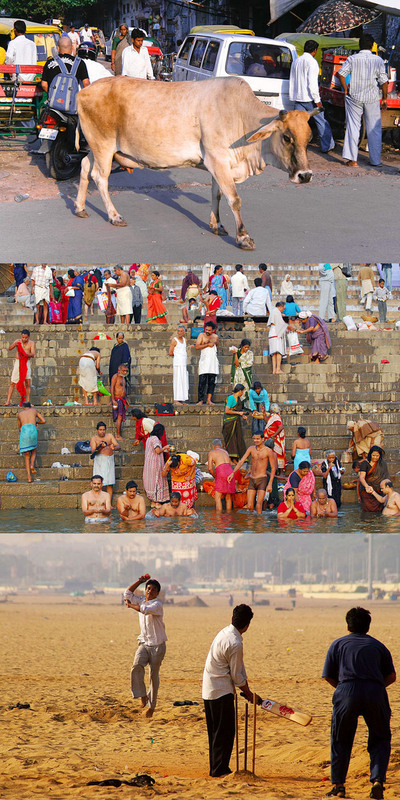 India is a large nation. It is inhabited by over one billion inhabitants.
 The most popular religion in India is Hinduism. It is characterized by the belief in reincarnation, where a person is born again after death, either as a human or an animal.
According to the old Indian caste system, a person is born into a specific social class. This means that the caste of a person's parents has an influence on what the person's social status, job and life will be.
Children that are born outside of the caste system suffer the most from this arrangement.
Because India is a large nation, it is home to a diverse set of religions and languages. The most important Indian religions (aside from Hinduism) are Buddhism and Islam.
In Hinduism and in Indian culture in general, the cow is a sacred animal. They cannot be killed or eaten. However, their milk is an important food product.
The river Ganges is also held sacred by Hindus. People travel from far away to wash themselves in the sacred river.
The most important Indian language is Hindi. India is a former British colony, which is why English is also an official language in India.
Many British games, such as cricket (pictured) and hockey are very popular in India.
Indian agriculture
The northern regions of India are located in the Himalayan mountain range. Tea shrubs are grown on the slopes of the mountains, and their leaves are hand-picked throughout the year. After this, the leaves are dried and sorted. Larger leaves are used to make high-quality tea, whereas smaller leaves and crumbs are used in tea bags. India is the largest producer of tea in the world.
The dry Indian savannas are used to grow wheat, peanuts and cotton. Rice is farmed in wet river valleys.
Agriculture is an important livelihood for many Indians. India is the second-largest agricultural producer in the world.

People collecting tea leaves.
The dry Indian savannas are used to grow wheat, peanuts and cotton. Rice is farmed in wet river valleys.
Agriculture is an important livelihood for many Indians. India is the second-largest agricultural producer in the world.
People collecting tea leaves.
Indian industry

India is rich in natural resources. Its large coal deposits are used to produce cheap electricity and heating.
The Indian bedrock is mined for coal, iron and bauxite, which is the raw material for aluminum. Iron is needed for constructing machinery and other devises. Aluminum is a light and durable metal, which is why it is used to make soda cans and airplanes.
India has become one of the leading industrial nations in the world. Every year, over 300 000 engineers and technical experts are trained in India.
The growth of the Indian economy has been rapid. The living standards of many Indians have improved, although millions of others still have to live in poverty and beg for food.
The Indian bedrock is mined for coal, iron and bauxite, which is the raw material for aluminum. Iron is needed for constructing machinery and other devises. Aluminum is a light and durable metal, which is why it is used to make soda cans and airplanes.
India has become one of the leading industrial nations in the world. Every year, over 300 000 engineers and technical experts are trained in India.
The growth of the Indian economy has been rapid. The living standards of many Indians have improved, although millions of others still have to live in poverty and beg for food.
Indian cities
 The northernmost parts of India are located in the Himalayan mountain range. Large amounts of water flow from the Himalayas to the large Indian rivers during the warm summer months.
 India is inhabited by over one billion people, which is more than in all European nations combined. The Indian birth rate is high, which is why the population continues to grow rapidly.
The capital city of India, Delhi, is located in the nation's northern part. The city of Mumbai is located on the shore of the Indian Ocean, whereas the city of Calcutta lies on the banks of the river Ganges.
Valokuvassa on kadun liikennettä Delhissä.
Although the population of the large Indian cities is growing rapidly, a large part of the population still lives in rural areas.
The lack of education has been a problem for a long time in India. Even today, every fourth Indian citizen is illiterate.
